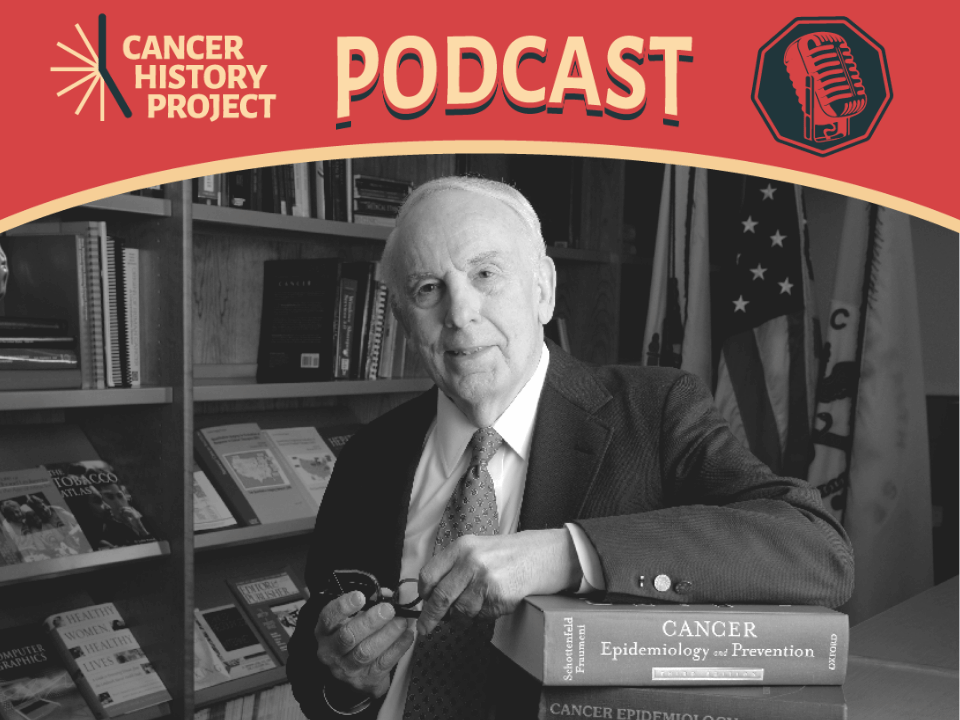
If a Mount Rushmore of Epidemiology were to exist, Joseph F. Fraumeni Jr. would be etched into the face of the mountain, former NCI Director Ned Sharpless once told Stephen J. Chanock.
Of the hundreds of scientists Fraumeni mentored, perhaps one of the closest was Stephen J. Chanock, his successor as director of the NCI Division of Cancer Epidemiology and Genetics, who worked with Fraumeni for 25 years.
Fraumeni died on June 22. He was 93.
Otis Brawley, co-editor of the Cancer History Project and the Bloomberg Distinguished Professor of Oncology and Epidemiology at Sidney Kimmel Comprehensive Cancer Center at Johns Hopkins University, interviewed Chanock on the most recent episode of the Cancer History Project podcast.
Brawley and Chanock looked back on Fraumeni’s 50-year long career. His contributions to science included co-discovering the Li-Fraumeni syndrome and developing cancer maps, which visualize cancer rate data from every county in the U.S. His work served as a backbone for other major discoveries, such as the two-hit hypothesis by Alfred Knudson and BRCA genes.
Read more about Fraumeni in The Cancer Letter.
Fraumeni developed theories around how cancer works and tested them.
“The mission statement of DCEG has been to understand the etiology of cancer through epidemiology and genetics as a means to prevention or early intervention,” Chanock said. “That’s really the wisdom of Joe Fraumeni who lived that, and really developed the tools, the capabilities, and the workforce to pursue that.”
As a result, Fraumeni established a vision of cancer’s genetic susceptibility. His observations about diethylstilbestrol raised “a very revolutionary idea” that early exposures could result in precancerous conditions and develop into cancers decades later. The cancer maps added a new attention to cancer caused by environmental exposures.
“These patterns were very important, which led to understandings about what was going on post-World War II and [how] certain occupations are associated with select cancers,” Chanock said. “This led to the birth of a whole set of cohorts and case control studies to look at asbestos, smelters, occupational hazards and smokeless tobacco use in the South.”
The goal was always to help patients, many of whom had no options at the start of Fraumeni’s career.
“What Joe was envisioning was the more we understand, the more we can be honest and explain to our patients who develop cancer or may develop cancer, what we could be done to prevent or decrease that risk,” Chanock said.
This interview is available on Spotify, Apple Podcasts, and YouTube.
The Cancer History Project Podcast is sponsored by City of Hope, the American Society of Clinical Oncology, the Sidney Kimmel Comprehensive Cancer Center at Johns Hopkins, and the University of Texas MD Anderson Cancer Center.
Related Articles
- Joe Fraumeni, founder of molecular epidemiology, dies at 93, June 26, 2026
- How the “Bad Luck” Cancer Paper was Misread by the Press, January 16, 2015
- Wittes, Fraumeni Appointed As Division Directors, February 9, 1996
- In Brief: James Institute Receives $9 Million Gift; NCI’s Fraumeni Wins Public Health Award, November 3, 1995
Episode Transcript
Sara Willa Ernst: Joseph Fraumeni Jr. was the director of NCI’s Division of Cancer Epidemiology and Genetics.
During his 50 year career, he discovered Li-Fraumeni syndrome, developed nationwide cancer maps, and laid down the foundations for modern epidemiology.
He passed on June 22 at 93 years old.
Stephen Chanock, his successor and current director of the NCI Division of Cancer Epidemiology and Genetics, worked with Dr. Fraumeni for 25 years.
In this episode of the Cancer History Project podcast, Chanock sits down with Otis Brawley, editor of the Cancer History Project and the Bloomberg Distinguished Professor of Oncology and Epidemiology at Sidney Kimmel Comprehensive Cancer Center at Johns Hopkins University.
And they talk about what Dr. Fraumeni meant to them, to the field of cancer epidemiology, and the hundreds of people he mentored.
The Cancer History Project Podcast is sponsored by City of Hope, the American Society of Clinical Oncology, the Sidney Kimmel Comprehensive Cancer Center at Johns Hopkins, and the University of Texas MD Anderson Cancer Center.
Otis Brawley: Hello, this is Dr. Otis Brawley. And I have the great privilege of today interviewing a dear friend of mine, Dr. Stephen Chanock, about another dear friend that we both lost—the world lost, really—in late June: Dr. Joe Fraumeni, the epidemiologist.
Just to let everybody know who Stephen Chanock is, he was a mentee of Dr. Joe Fraumeni, and ultimately, was Dr. Fraumeni’s successor as director of the Division of Cancer Epidemiology and Genetics (DCEG) at the National Cancer Institute. In that job, he gets to lead one of the world’s leading epidemiology programs.
And Stephen grew up at the NIH. We sort of think of Stephen as NIH royalty because his father was an investigator and an incredibly well-noted scientist at the NIH. And Stephen went away to the Northeast to train for a while, then came back to the National Cancer Institute and got to work with Dr. Fraumeni for, I think, more than 40 years. Isn’t that right?
Stephen Chanock: A little bit less, but that’s all right. 25, yes.
Otis Brawley: Okay, but a long, long time.
Stephen Chanock: 25 to 30. Oh, absolutely.
Otis Brawley: Yeah. So, thank you for joining me today as we remember our friend. For those who don’t know, Joe Fraumeni was 93 years old when he died. He came to the National Cancer Institute in the 1960s and just became an amazing force.
Ned Sharpless, the former director of the National Cancer Institute, said something that just totally blew my mind. I wish I had come up with this comment because it’s so true. And he said that if there was a Mount… How did that go, Steve?
Stephen Chanock: He said, “If there was a Mount Rushmore, Joe Fraumeni would be on it with Sir Richard Doll, Richard Peto, Florence Nightingale, and John Snow.”
Otis Brawley: Yes.
Stephen Chanock: And what’s amusing is he created a small AI meme that he sent to me that shows them on it. And he used the image of Jon Snow from Game of Thrones, not the John Snow that we think about [from] hundreds of years ago.
Otis Brawley: For the few folks who don’t know, John Snow was a British physician who, in the mid- 1800s, was able to figure out that the cholera epidemic in London was because of one specific water station. And it was sort of the birth of modern epidemiology that John Snow would figure this out and save a lot of lives.
Stephen Chanock: Exactly. Absolutely.
Otis Brawley: Yeah. So, tell us what you think of as Joe’s greatest achievement.
Stephen Chanock: Well, his greatest achievement is really in the plural, in my mind. And I think I would divide it into sort of three or four categories. Of course, there’s Li-Fraumeni syndrome [about which] Joe, back in 1969, published the iconic, very important paper with Fred Li, his long-time collaborator, where they had investigated, basically, four large families that had multiple cancers in that family.
And this was a paradigm shift because, until that time, there had been the recognition that there could be cancers in a family, but usually the same cancer is what people were focused on. And I would go back as far as Paul Broca, the famous French neurobiologist, who noted in his wife’s family some more than a dozen women with breast and ovarian cancer back in the 1850s, and actually wrote a tract on that.
So, what I think was so important about the Li-Fraumeni syndrome paper was it told us that the susceptibility to cancer was probably greater than—and more complicated than—we had previously thought. And that it really engaged multiple cancers, as opposed to just breast cancer, or testicular cancer, or prostate cancer.
So, I think that led to a very modern and very new vision of what cancer’s genetic susceptibility would look like. And shortly thereafter, Al Knudson had done that beautiful mathematical modeling and came up with an understanding of the two-hit hypothesis for retinoblastoma. And then we moved forward into the age of really identifying highly penetrant mutations such as BRCA1 and 2 and other genes.
And so, I think that Dr. Fraumeni’s contributions really focused on being very, very precise, and understanding exactly how families would inform us to then know where to go to ask very important biologic questions. I think the second thing that he’s really very well-known for is really laying down the foundations for modern epidemiology by really pushing and really developing the cancer maps where he looked by state. And then when he looked by counties in the United States, he could see patterns.
And these patterns were very important, which led to understandings about what was going on post-World War II and certain occupations are associated with select cancers. That came out of looking at these maps and seeing that there are different parts of the country that then you had environmental and then eventually trying to look at ancestral… why certain populations had greater risks than others.
And so, this led to the birth of a whole set of cohorts and case control studies to look at asbestos, smelters, occupational hazards and smokeless tobacco use in the South. This is something that goes back in time that the current generation doesn’t appreciate just how important his observations were in setting up the structure to do that.
I think his development of the whole field of molecular epidemiology comes back to the first point, thinking about how you collect and sample so that someday there’s a technology or a way to connect genetic susceptibility with environmental factors to understand how and why cancers start and progress. That is truly one of the gifts that he had given to us.
And the last thing I would say, he’s known as just a remarkable mentor who saw things in people long before others would, and gave people responsibilities, and encouraged people on the basis of their innate abilities, not on the basis of either their pedigrees, or their sex, or their race, or their ethnicity.
He saw where they were really good scientists and his view was, “You bet on the good people. You don’t bet on people because they are something.” And that was a very special trait that I think led to his really encouraging and mentoring, both directly and indirectly, people around the world, and encouraging people who were talented to ask the questions and do the kinds of things that he did, which is ask questions about patterns.
Because epidemiology is really about accumulating enough information so that you can ask very important questions of relationships and associations—that then you can infer mechanisms and develop new hypotheses and, very often, make public health determinations based on the strength of that evidence.
And Joe Fraumeni… I mean, he was known as Dr. Fraumeni to everybody, and that was a special category when you got to call him “Joe,” and only a few people would dare do that. But he took very young people who had only masters and things like that and put them ahead of studies, ahead of people who had PhDs and MDs, because he saw that they were the talented people, and his bets almost always paid off. Had he worked at the racehorses, he would have been a very rich man.
Otis Brawley: It’s interesting. I was talking to one of his former students and mentees who said, “Dr. Fraumeni saw in me things that I did not see in myself and then set out to make sure that I saw them, too.”
Stephen Chanock: Well, that’s the thing about Joe. He was incredibly well-read, and he thought of things in different ways than most other people. When you had a conversation with him, he always had some fact, or some paper, or something where he would send you that was informative.
And what was particularly remarkable about him is—I knew him in the last sort of 25 years of his sort of 50 years of science. He would send you to things and you would go look up, and you’d say, “Gee, he first noticed this 40 years ago.” So, he was the person who… He was one of the lead people in really pursuing the diethylstilbestrol story. And that was a very important thing in terms of the pharmacology and the fact that this drug had terrible toxicity, but it raised a fundamental question that not many people were thinking about it.
That is, early exposures could have a long time lag and then [result in] the development of cancers or precancerous conditions 20, 30, 40 years later across generations. That was a very revolutionary idea. His career is filled with it. When you look at his CV, things that he noticed that then he may not have spent his career pursuing that, but others picked up on that.
Otis Brawley: Yeah.
Stephen Chanock: I mean, this is somebody who had a golden touch with respect to asking questions.
Otis Brawley: I sometimes have referred to myself as the “Forrest Gump” of medical oncology. Let me give you an example of why. I was once with him on a bus at an ASCO meeting and along comes his good friend, Dr. Al Knudson (of the two-hit hypothesis, for the young folks here).
And he introduces me to Dr. Knudson, and we have a wonderful conversation, and Al Knudson was a baseball fanatic. He talked about the St. Louis Cardinals when they were the furthest team west in the United States. And at some point, Dr. Fraumeni decides to talk about gene environmental interactions. And Yogi Berra is famous for saying that, “Baseball is 90% physical and the other half is mental.” Fraumeni says, “Cancer is 90% genetic and the other half is environmental.”
Stephen Chanock: Well, by the time I started working with him, he would say to me, “It’s 100% genetic and 100% environmental. Go figure that out.” That was his charge.
But no, there’s no question. He always seemed to know something that you didn’t know, and he was very polite about it. There was no fear of a conversation with him other than [that] you didn’t want to embarrass yourself. He didn’t dress people down.
He would simply point out, “Well, maybe there’s a paper you should read. Or did you consider such and such?” He was very gentle. I mean, there are other people I’ve worked for at the NCI who I admire greatly, that was like getting in the ring with Joe Lewis. You had to be ready for that.
Otis Brawley: Now, he was into asking the hard and important questions, not the fashionable questions.
Stephen Chanock: Right.
Otis Brawley: I remember him saying, “Don’t ask the fashionable questions. Ask the hard questions.” He combined clinical observations and then put rigorous epidemiology behind them. And you mentioned he recruited diverse people, women, Blacks, Asians.
Fred Li, early, early collaborator of his—also, a wonderful man who I got to know—actually recruited me to write my first paper, as a matter of fact, when he was editor of Cancer Epidemiology and Biomarkers. This is back in the early 1990s. But Dr. Fraumeni found clinicians, statisticians, molecular biologists, geneticists. You’re a geneticist, right?
Stephen Chanock: Yeah. I’m trained as a clinician, but I’m interested in genetics. But I’m interested in epidemiology now, because he taught me a lot of it. He once said, “Look, you don’t have to be an epidemiologist to become an epidemiologist. You just need to be smart to become an epidemiologist.”
Otis Brawley: I’m thinking about Mitch Gail, who started out as a physician-statistician who did epidemiology, or Peggy Tucker, who did a lot of the early work telling us about melanoma and familial melanoma.
Stephen Chanock: Yeah.
Otis Brawley: How do you categorize Bob Hoover and Bill Blot?
Stephen Chanock: Well, they were true giants. Joe Fraumeni was truly a gentle giant, and he collected giants around him… somebody like Bob Hoover, who had this extraordinary wisdom and understanding of the trajectory of epidemiology, and that was very special.
Bob could see a problem over a period of time and see how the research had progressed, what was missing, and what needed to be filled in, so to speak, or what needed to be done next. And same with Bill Blot. These were incredibly inquisitive and thoughtful people.
Bill was faster-moving and Bob was very philosophical. Bob would write these extraordinary, long philosophical emails in response to a single question about why you should be worried about your strategy for sampling for a genetic study or an exposure. And it was like a textbook. I saved a bunch of these because they’re so good.
But having these kinds of people, like Deborah Silverman, who was somebody who Joe recognized, sent her off to get a PhD—she’d been working with him as a master’s. And he said, “This is a talented person. Put her ahead of something.” And then sent her to get a PhD so that she had her credentials. And she was an incredibly productive, marvelous leader within our program in occupational epidemiology and looking at bladder cancer in many different ways and exposure.
Otis Brawley: Diesel exhaust and bladder cancer, right?
Stephen Chanock: Exactly. And arsenic. And so, this is his sort of legacy of finding these people. And there are wonderful young people or mid-career people here who Joe inspired or brought in and have flourished. So, there was this marvelous capacity to be a casting director, so to speak, and his movie is a true blockbuster.
If you were to make a movie of what he did in epidemiology, it would win lots of Oscars and he’d have all these marvelous supporting actors and actresses who’ve gone on to marvelous careers. And there are people who were away in other institutions—I can tell you that with his passing, heard from many people in China across Europe, South America—all talking about the influence that they had on his life, and how he encouraged them either at a distance or very directly, and wanted to see people answer the important questions.
Going back to his philosophy, I think it’s helpful to get a sense of what he was like. He had this big office with a big table, and you came in and you sat on these smaller chairs, and he was higher up than you, always. He didn’t speak loudly, but there was this presence.
And then there were two things that were on the wall. One was a famous New Yorker cartoon of a row of birds perched on a rooftop all facing one way, except one that was facing the other way. And he would say, “Well, that’s the epidemiologist who’s looking at the patterns differently than everyone else.” And then you have to think about how you got to where you are.
And then there was this Kanji (the Japanese calligraphy) on the wall that read, “When you drink the water, don’t forget who dug the well.” And this was something that he would remind people of: We are all parts of a longer trajectory and don’t forget who came before you. And he would say, “We have to know who’s going to come next, and be sure there is a next, because most of these questions are difficult and take a long time to answer.”
Otis Brawley: Many people don’t realize that the Public Health Service has a uniformed Commissioned Corps, a military service. And he was a… Actually, he loved the fact that I knew that a two-star admiral is a rear admiral (upper half). That’s the real rank. That’s the name.
Stephen Chanock: Right.
Otis Brawley: He had two stars and he had his admiral’s flag in his office at one time.
Stephen Chanock: Oh, he had it always in his office. He had an American flag and an admiral’s flag behind him. And when he retired, in the small office that he had—they were there. And I can tell you in the retirement home that he was in, I took them there and set them up, and his face just beamed that he had those two things. Those were so important to him.
And we arranged for an American flag that’s flown over the Capitol—a few years ago—to be presented to him. And this was very important, because he, indeed, was a true public servant and patriot.
I can tell you that growing up in a house where my father was at NIH for 50 years, we had a poster on our kitchen wall that I still live by, and it’s in my own house. It’s, “The noblest motive is the public good,” of Virgil. And Joe really lived that. I had shown that to him many years ago and he said, “Yes, I know that.” He said, “I don’t need to have that on the wall. I know that. And I live that.”
And I think it’s safe to say that his commitment to advancing the health of not only the American people, but the international community, was really quite striking and quite important. And I don’t think we realize the effect that it’s had in so many places around the world, as well as in our country, and this public service was very important to him.
And I think he’s taught that to a lot of people here. The ‘why’ and ‘what we do’ is not for—he would say, “It’s never for your individual glory. It’s not interested in getting the brass ring. It’s what you do for others.” And if you walked into his… The other point I would make about his office was [that] he had numerous awards that he’s won, and they weren’t on the wall.
The only thing that was on the wall was the National Academy of Science, a diploma, but that was in the little conference room, not in his office. He didn’t have the Mott Award, the Snow Award, the General Motors Cancer [Research Foundation Award], all these things. They were all at home in the corner of the living room of his house—not even displayed, but just sort of sitting there against the wall.
This was a man who—it was not about him It was about what he could do to advance what he thought was the important mission of the National Cancer Institute.
Otis Brawley: Even late in his years, he was still very interested in the science. Wasn’t he quizzing you about thyroid and kidney cancer?
Stephen Chanock: Yes. After he retired, I would see him often and I would tell him how the Institute was doing, or DCG. Three weeks before he passed away, I went to see him. He was quite physically ill, but mentally with it. I walked in the room and the first thing he asked about was my wife, who he thought was wonderful, and I think my wife’s wonderful, too, and my eight grandchildren and four dogs, and he could name three of the four dogs.
And then he said, “Well, how’s it going in figuring out the relationship between genetic susceptibility to thyroid and kidney cancer?” Because this is a 20-year conversation, he said, “I know there’s something there. Figure it out, Chanock.” And I’ve been working on this.
And we’re making small headway on this, but he said, “There’s got to be something. There’s something about those two cancers that’s connected.” And here he was, 93 years old, very infirm, just recovering from an aspiration pneumonia and he’s asking me about that. So, I talked to him for a little bit and he smiled and said, “Good, just keep up the good work.” That was the next-to-last thing he said before I left, having visited him in the hospital that time.
So, he always thought of the long-term questions. And the patterns were very important when talking with his family, for instance, with his nieces. And actually, I’ve seen his brother recently, around the funeral. The stories were that he always was looking at patterns.
And like Al Knudson, who loved baseball statistics, Joe loved the Red Sox, and he looked at patterns in baseball, but it wasn’t just for the Red Sox. It was, “How do you make sense of… how do you predict based on things that people have done before?” He had this very curious mind that, thankfully for the rest of the world, he set it on epidemiology.
And this was all dictated, so to speak, dictated to him when he was a fellow at Sloan Kettering. Was it Rulon Rawson, who was the distinguished thyroidologist, started to challenge him to look at patterns again of thyroid cancer and other cancers, and kept saying to him, “Well, you see patterns. You see epidemiology.”
And that was, according to Joe, very important and extremely influential in being able to confirm what he was interested in as a young, bright, very, very inquisitive clinician. And the rest is history. We have much to be thankful for what he then subsequently pursued and did.
Otis Brawley: And how many students do you think he had just at DCEG? I say just at DCEG because I know people at IARC over in the World Health Organization, Geneva, and in Lyon who think of themselves as being mentored by Dr. Fraumeni. I know people at Harvard and the Chan School, and people at Hopkins and the Bloomberg School, or even at the Rollins School at Emory, all of whom think of themselves as having been mentored.
But how many people did he bring into the fold at the Division of Cancer, Epidemiology, and Genetics over the years? Can you guess?
Stephen Chanock: Oh, yeah. I’ll answer this in two parts. I suspect in the hundreds, probably 500 or more people, he influenced directly. But I think that if you want to write that number, it has to be in scientific notation. At least something times 10 to the third in the thousands who he directly influenced and accelerated or encouraged, assisted, advised in their careers.
And he did it in lots of different ways. He had plenty of people who were part of the DCG network, and as you mentioned, people in other places in U.S. academics and international organizations, and he always wanted to talk with the younger generation. They would be summoned to his office.
And if you got summoned to his office, your blood pressure was always up, like, “Okay, why am I going to Dr. Fraumeni’s office? What does he want?” And he never went to a meeting where he wasn’t more prepared than everyone else in the room for what the meeting needed to discuss and accomplish.
But he loved to talk with the younger investigators and tell them, “What are the problems? What do you think?” And he frequently said, “Go out and read. You got to read. You got to be educated. You got to think about what you’re doing. And if you know the literature, you can know what may need to be done next and what doesn’t need to be done next.”
Bias was a very important word in his mind. You have to appreciate what your biases are at every step and sometimes say, “I need to get around them,” or, “I need to think outside the box.” Like that one bird on the rooftop in The New Yorker cartoon—look the other way and maybe something will be evident.
Read more and think hard about the long game. Those are words that sort of resonate in the back of my mind when I think of the number of conversations I had with him.
Otis Brawley: Yeah. I’m just thinking about the importance of what you just said, about how each of us needs to appreciate our biases. I mean, science would be so much better off if some people would sit down for a second and actually reflect and be contemplative the way Dr. Fraumeni was.
Stephen Chanock: Yeah. And he thought about things. And then what he also was very good at doing was helping people to be more concise and clear in their writing. He was an amazing editor and it was a privilege to work with him, to send a manuscript to him. He would take out his No. 2 pencil and he would first touch the lead to his tongue.
I always worried that he was going to die of lead poison[ing] because [of] the number of times he would touch his tongue, and then he would go start writing. And you would get your paper back with many suggested edits. Suggested is a gentle word of saying, “This is the better way to do it.” And I would say 99 out of 100 times, he was spot on.
And then there were comments on the side, and sometimes he’d say, “Go look this up. There’s a PNAS paper that you need to see.” Or, “Somebody published this in Lancet; shoot it down.” So, there would be these extraordinary commentaries. I still have a drawer with, probably, 20 manuscripts that I sent to him that I held onto his written comments because it was like sending something to Charles Dickens. It was rewritten in a much clearer and better way, and I was challenged to do things I hadn’t thought of that then improved the paper or proved what the scientific process was. But there were some people who were terrified of his No. 2 pencil, which is very funny, because I’ll tell you a story of, for years, we still have what we call the distinguished or visiting scholars.
Somebody comes and spends two days at DCEG, gives a lecture, and Joe always had a bunch of tchotchkes; you’d get a pen and you’d get a keychain holder or whatever that had ‘NCI’ on it. But he always gave them, also, a little box of pencils, and he said, “This is for your editing.” And he would always say that. So, he was less than subtle at times about that.
Otis Brawley: Well, I still remember once I was in a meeting with Martha Linet, who was very famous for ionizing radiation, leukemia, lymphoma, and Peter Boyle, who I was very close to, and Peter Boyle referred to this paper he had gotten back as having been ‘Fraumenied.’ He turned it into a verb.
Stephen Chanock: I’m not surprised. Yes.
Otis Brawley: No, it was just absolutely… These were… You and I are very fortunate that we work in a world where we can have folks like Joe Fraumeni and the wonderful folks that he surrounded himself with who were all very nice. And I think Joe Fraumeni would actually say his greatest contribution was all of those people that he brought into epidemiology.
Stephen Chanock: I think that that’s a very, very accurate statement. I think he was very proud of that and the notion of team science. And he would encourage younger people or mid-level career people, “Go find people who have complementary expertise and hear what they have to say, and see if there’s a way that you can work together to solve things. Because no one person can solve it from their one perspective.”
And that was a very powerful approach. That when, now, everybody talks about team science, that’s the lifeblood of DCEG and has been for… DCEG is 30 years old, but even well before, that when there was a different entity, that was Joe’s style. He wanted to make the cancer map, so he wanted to talk to the cartographers, to the epidemiologists, to the statisticians, to the people who were doing occupational health, and say, “Let’s all sit in a room and look at this from our different perspectives and figure out how and why certain exposures may or may not be associated with cancer, like arsenic or whatever. Where’s that coming from? What do we need to do to solve that problem? Because you can’t do it yourself.” I think he felt that the world was really best as a collaboratory, not a laboratory. Working in teams.
Otis Brawley: He was very quick to meet various public health needs, and what I’m thinking about is back in the 1980s when, all of a sudden, we started having people getting pneumocystis pneumonia and dying. Even before we called it the acquired immunodeficiency syndrome (AIDS), he supported a lot of work that helped us to do some of the original epidemiology descriptive and otherwise in HIV/AIDS.
Stephen Chanock: Correct. And he saw that cancer was part of that challenge, and he brought people like Bill Blattner and Bob Hoover and others looked at these problems. And Blattner really had a very distinguished career in beginning that characterization, and that continues to this day with people like Eric Engels and Meredith Shields who were looking at the long-term consequences of chronic HIV infection, and how we see the patterns of common cancers, as well as the AIDS- or the HIV-specific related cancers, have changed with therapies, and there are increases in select types of cancer, but not in others. And Joe is the kind of person that would ask, “Well, why is that so? What does it tell us about the difference between lung cancer and prostate cancer? How important is immunosuppression or an immune dysfunction for one versus the other?” And again, this is the way he was always looking at these patterns, and coming back to the thyroid and kidney, to him it was like, “Yes, there’s genetics, but what is it about the response to particular exposures like radiation? Why [do] you see thyroid cancer so sensitive to that? But you don’t see kidney [cancer], but they share other things. Make sense of that.”
I mean, he continually was grappling with these tough questions and sort of trying to challenge people to think in new ways or ask questions with resources or new tools that molecular epidemiology was incorporating from genomics and proteomics and exposomics and things like that. And he always loved to know what was new.
When I would go see him over the last couple years, he always wanted to know, ‘What’s new in genetics? What new tools are there? What’s it going to change? How are we going to be able to apply this? When can we do this in large populations so we can better understand parts of the genome that we haven’t interrogated with genome-wide association studies?’ His mind was always going to the places where we hadn’t been successful yet, and how can we be successful in those places.
Otis Brawley: Yeah. A lot of people who listen to this podcast are people who treat cancer. We have doctors, we have nurses, we have other folks who are very interested in cancer treatment. They may not be as aware of what epidemiology is… what a genetic epidemiology is, and how it relates to carcinogenesis, as well as cancer prevention, and in some instances, not just cancer susceptibility, but how you treat the disease. You want to tackle that a little bit?
Stephen Chanock: Sure, sure. And I think that the… I’ll do this sort of through the career of Joe Fraumeni, going from really noticing patterns on the war to trying to understand why certain people were getting cancer and some people weren’t who were exposed. The age-old conundrum of cigarette smoking: it’s an incredibly high-risk thing to do, but not everybody who smokes develops cancer. Why is that? He wrestled with those questions.
And so as we try and understand the etiology, or the basis, for this and how the different risk factors, the choices that we make or the things we’re exposed, to affect our bodies so that we may or may not develop those cancers. Joe was one person who really saw that it was important scientifically to do this so that we could prevent and intervene, but also in terms of treating the whole patient because, I mean, I was trained as a pediatric oncologist and spent many years doing pediatric oncology.
And there was not a single circumstance where we, sadly, diagnosed a child with cancer, and the mother and her father [wouldn’t] say, ‘Why did this happen? What is going on? I don’t understand.’ And then they would spend a tremendous amount of emotional and spiritual energy trying to figure out what’s the cause of this? What did they do? What were they exposed to? Why is this in the family or whatever?”
And in a sense, what Joe was envisioning was the more we understand, the more we can be honest and explain to our patients who develop cancer or may develop cancer, what we could be done to prevent or decrease that risk. So, a very good example that I know he was very keen and talked a lot about was the National Lung Screening Trial (NLST)—the one Chris Berg and others ran of using low-dose CTs to look at people who smoked a certain amount. That was really an important implication of studying smoking and how much he wanted. Joe worked hard to try and quantify with Bill Blot and others how much smoking actually caused… How much you smoked; what did that mean for your risk?
But the NLST was really important because there was now something that could be done. If somebody had this exposure, you could then go be screened and be followed and, presumably, detected at an early stage and have a greater likelihood of successful treatment. So that whole trajectory going from the epidemiology to the prevention and early intervention was always in the forefront, not the back of his mind.
The mission statement of DCEG has been to understand the etiology of cancer through epidemiology and genetics as a means to prevention or early intervention, and that’s really the wisdom of Joe Fraumeni who lived that, and really developed the tools, the capabilities, and the workforce to pursue that.
Otis Brawley: Yeah. It’s interesting. Chris Berg is a grand example. She’s a radiation oncologist who ended up running what I still think of as the best-designed, best-run screening study in any disease ever done.
Stephen Chanock: Yep. Chris is a hero of mine and a very dear friend and I know a friend of yours as well. She did it, and honestly, she talked with Joe a fair amount.
Otis Brawley: I know.
Stephen Chanock: I mean, she looked to Joe as someone who really understood, and the rigor and the structure with which Joe thought about by planning, conducting, analyzing, interpreting, and communicating, that whole paradigm was so important to him. And there are people throughout the world who were influenced by how he did it and saw how he did it.
Otis Brawley: Yeah. He truly was someone who was very orthodox to the science, someone who taught people to respect the science and to be orthodox to it. And the world is a better place because of his work.
Stephen Chanock: Yep.
Otis Brawley: I knew him. I got to work with him. I got to interact with him from my time. I got to the NIH back in 1988 and I think I met him in 1989 for the first time. I last saw him just a couple of years ago at a reception where he got the American Cancer Society Medal of Honor. And he was there with Joe Biden, of all things. Former Vice President Joe Biden at that time.
Stephen Chanock: Oh, I remember. I was there. Yes.
Otis Brawley: Yeah. And that was a very good time. I’m glad that he was able to realize that people really appreciate him and respect him. I’m really glad that he was able to see that.
Stephen Chanock: I couldn’t agree more, and I think that meant the world to him. He won many of these awards. He didn’t show them off, but I think the receipt of them resonated very deeply with him, and his wife, Patricia D’Arcy Fraumeni, who was very committed to him. They were married some 49 years and she was involved in his life and supporting him in so many wonderful ways.
Otis Brawley: She just died recently, correct?
Stephen Chanock: Yeah. She died in February. Yes. Yes, she did. And I would also say that Joe was a true New Englander. Born in Massachusetts, went to Harvard College, die-hard Red Sox fan. When he was in the hospital or in one of the different nursing homes he was in when I’d see him, he always complained, “Where can I get a lobster tail?”
So, several times I showed up with a lobster tail and mashed potatoes and his eyes just lit up. Or Shelia Zahm, who was his wonderful deputy, visited him and would always bring him an Italian sub, which—those were the two things that he really loved to go back to: his heritage.
But when I think of him, I really think of this wonderful quote of a hero of mine, Ralph Waldo Emerson, whose enduring words were, “Do not go where the path may lead. Go instead where there is no path and leave a trail.” And by God, Joe really did that. He lived that.
Otis Brawley: That’s so true.
Stephen Chanock: And it’s so true. It’s such a marvelous way of characterizing just the depth and the breadth of his impact and his influence that will continue to ripple for generations. And I feel that our… Otis, you and I have to be sure that the next generations realize this.
Look, we’ve grown up. I grew up in the shadow of parents that were raised during the FDR times. He was a remarkable president in many ways. There were issues with him, but I was taught that by my parents. I think we have to teach the next generation how remarkable a kind of influential figure and scientific expert and member of, as Ned Sharpless said, the Mount Rushmore of epidemiology, Joe Fraumeni was. That’s our task.
Otis Brawley: This is a good way to end this. I’m going to say one other thing is I’m envious that you got to spend so much time with this great man. I knew him, but you knew him.
Stephen Chanock: Well, I feel very blessed that I could do that. And carrying the torch now, running the division for the last 13 years that he set up. We stand on the shoulders of this, what I would call very gentle but very, very giant person.
Otis Brawley: Yeah. Well, this is Otis Brawley, editor of the Cancer History Project and from the Kimmel Cancer Center at Johns Hopkins, talking to Dr. Stephen Chanock, who’s director of the Division of Cancer, Epidemiology, and Genetics at the National Cancer Institute. I just want to say thank you to Stephen. I want to say thank you to the folks who arranged the recording of this podcast.
Stephen Chanock: Well, I’d like to say thank you for the opportunity to talk about Joe Fraumeni. And, Otis, it’s always a pleasure to talk with you, particularly about a shared favorite topic, such as the legacy of Joe Fraumeni.
Otis Brawley: Thank you.
Stephen Chanock: Thank you.