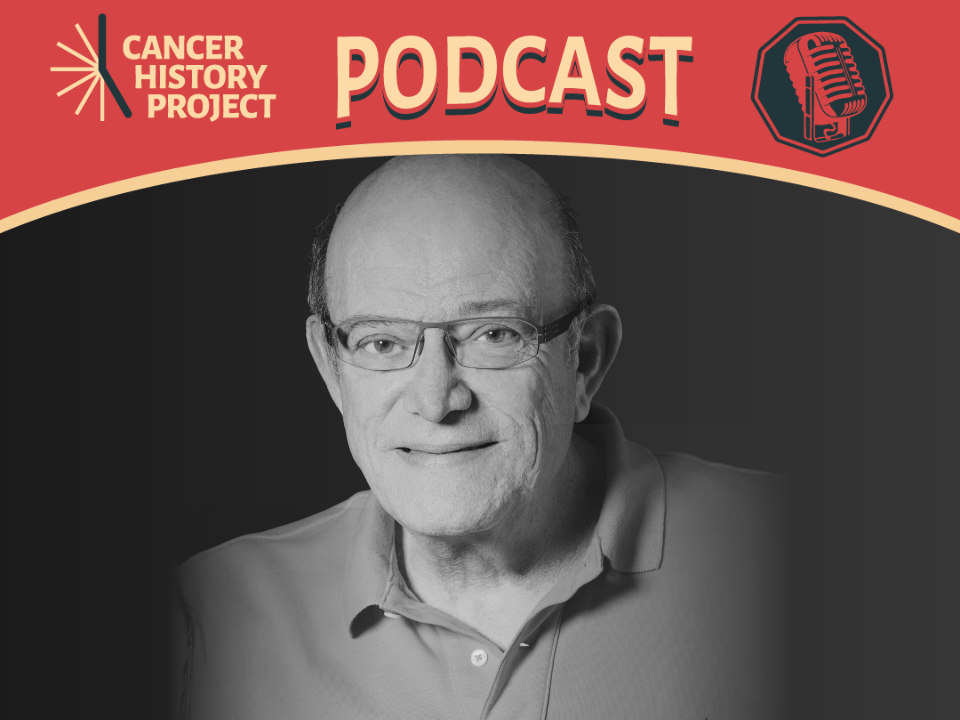
When Bernie Lewinsky was a young radiotherapy resident, he studied under some of the most storied names in the field. Now, over fifty years later, he marvels at how much radiation oncology has changed.
“You’ve gone from a betatron, cobalt and radium needles, and treating AP one day and PA the next, to probably treating on some sort of amazing [technology like a] TrueBeam or Elekta,” said Stacy Wentworth, a radiation oncologist at Duke University School of Medicine, who hosted this episode of the Cancer History Project Podcast.
Lewinsky was one of the co-founders of the Endocurietherapy Society, which now exists as the American Brachytherapy Society. He has also helped develop the first group of freestanding radiation therapy clinics in Los Angeles, CA.
Throughout the years—whether during his rotation at the Royal Marsden Hospital in London during residency or participating in tumor boards at UCLA—he has been part of many fervent debates with radiotherapy legends, arguing over whether Hodgkin’s lymphoma spreads up or down the body, and the legitimacy of Intensity-Modulated Radiation Therapy in the early days.
“Now it’s so much more accurate, so much different and so precise,” Lewinsky said. “When you start talking about blocking the nodes in the heart to stop arrhythmias, we’re very specific.”
Lewinsky brings a treasure trove of artifacts to the interview—written orders of radium needles from 1948, an attachment that connected to an orthovoltage machine, a Mick applicator, and even a Bunsen burner. He plans to send some of these relics to the archives at ASTRO or the American College of Radiology.

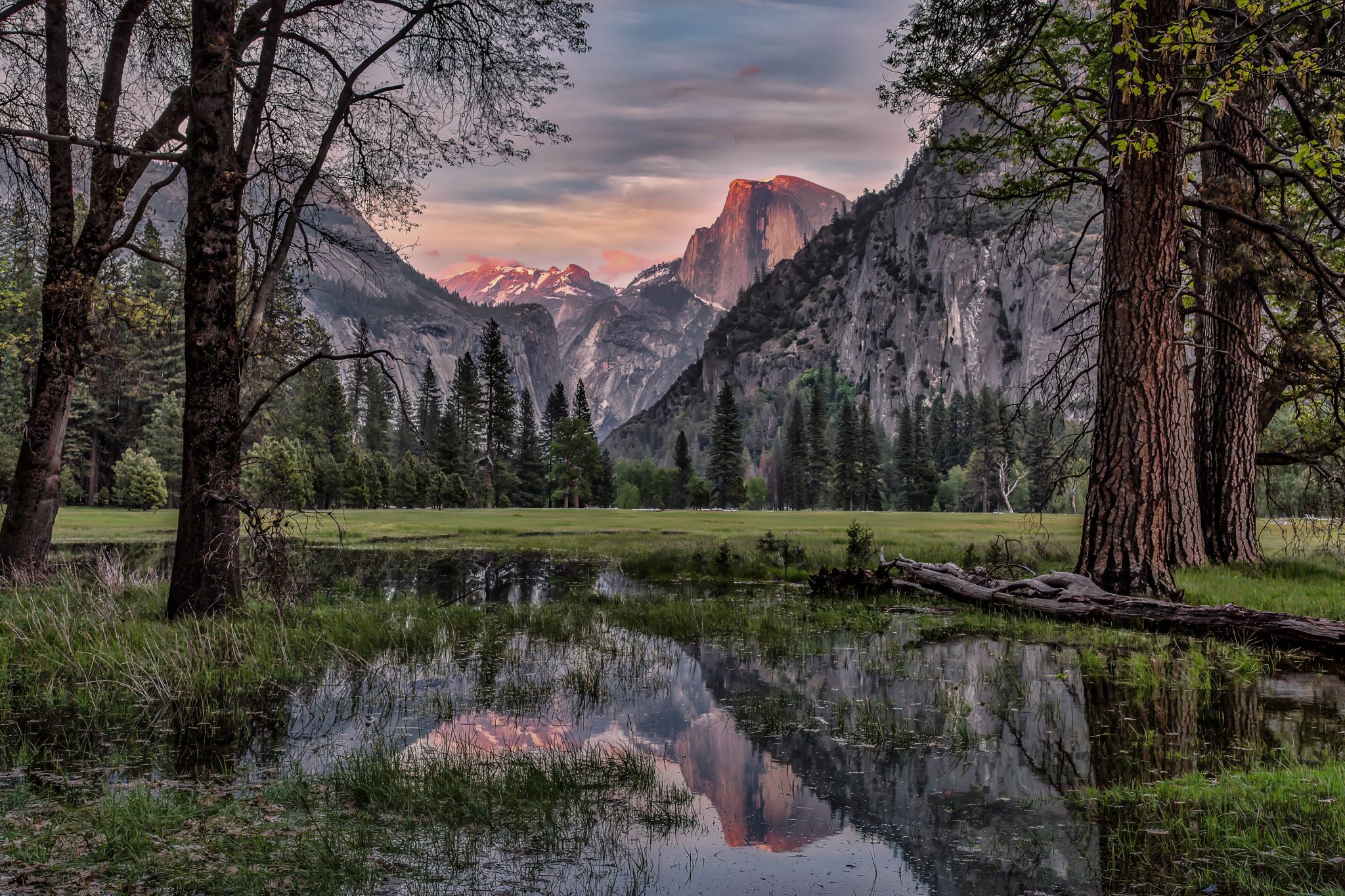
Beyond his practice of medicine, Lewinsky has also brought healing to his patients through his landscape photography. Some of his first photos captured an active volcano in El Salvador, where he grew up. Prints of some of his photographs can be found on the covers of academic journals and on the walls of his office.
He distinctly remembers one patient, whose attention drifted off during an office visit. Lewinsky says the patient was struck by a photo of cherry blossoms he took in London.
“I said, ‘Wait a minute, what is it about that picture that’s got you mesmerized?’ and he says, ‘I remember when I was a little kid, my dad would take us cherry-picking. I sure wish my dad was here right now,” Lewinsky said. “It became my observation that there is a healing aspect to nature photography and putting it in the office when a patient is under tremendous stress, it not only calms the patient, but it brings back memories that they cherish.”
A selection of Lewinsky’s photographs appears at the bottom of this article.
This oral history interview is available on Spotify, Apple Podcasts, and YouTube.
Related Articles:
- Melvin J. Silverstein on DCIS, breast cancer surgery, and building the first free-standing breast center, June 2, 2025
- Weeks before death from sarcoma, Norm Coleman reflects on career in radiation oncology, addressing health disparities, March 22, 2024
Episode Transcript:
Katie Goldberg: The Cancer History Project is an online archive of the history of oncology, collaboratively curated by the institutions and people who shaped it.
We have over 60 partners, spanning academic cancer centers, government agencies, advocacy groups, and even the occasional podcast.
Visit us online at cancerhistoryproject.com to dig through our archives.
Sara Willa Ernst: Bernie Lewinsky is a radiation oncologist. He has had a decades-long career. He has seen radiation therapy science just transform since his start in the 70s. This was before CT scans and 3-D imaging, when there were ongoing fights between local vs. systemic treatment of cancers, when there was less of a focus on preserving the breast in breast cancer, for example.
So imagine, the typical tools of today—brachytherapy, a linear accelerator, and more precise image-guided therapy—these were just not part of the standards of care.
He was treating cancers with betatron machines, orbital implants with radium needles, X-rays, and blurry brain scans.
So let me give you a little background on Dr. Lewinsky: he was born in El Salvador and moved to San Francisco at the age of 14. Out of residency, he became an army doctor—the chief of radiotherapy at Letterman Army Hospital in San Francisco, and later helped develop the first group of free-standing radiation therapy clinics in LA.
You might recognize his name from his daughter, Monica, but in oncology Dr. Lewinsky is known for being one of the co-founders of the Endocurietherapy Society, which expanded into what we know today: the American Brachytherapy Society. He is also an accomplished landscape photographer. You can find his photos on the covers of academic journals and on the walls of his office.
On this episode of The Cancer History Project Podcast, Dr. Lewinsky talks shop with fellow radiation oncologist Stacy Wentworth, and brings with him relics from a bygone era of radiation oncology—a little show and tell of artifacts that he’s sending to the archives at ASTRO and ACR for safekeeping.
The Cancer History Project is sponsored by City of Hope, the American Society of Clinical Oncology, and the University of Texas MD Anderson Cancer Center.
Stacy Wentworth: Thank you so much for being here, Dr. Lewinsky. I’m Stacy Wentworth. I’m a radiation oncologist at Duke University School of Medicine, and I am pleased to be joined with Dr. Bernie Lewinsky who is joining us from California.
Would you like to introduce yourself and then talk a little bit about how you got interested in medicine, where you grew up, that sort of thing?
Bernie Lewinsky: Okay, thank you. It’s a pleasure to be here. I have a long history. I’m now 82, so there’s a lot of history there.
I was born in El Salvador and I grew up there until I was 14. I came to this country because we ran out of American schools that we were going to. It stopped at the eighth grade. So we moved to San Francisco. In San Francisco, you always go to Berkeley, so I went to Berkeley for college.
It was the era where Sputnik came out and President Eisenhower came and spoke and said, “We need engineers,” so I was going to go into engineering. I was interested in electronics. I built radios and ham and all of that and went to apply for the entrance exam at Berkeley and I flunked it royally. So I said, “I don’t think I’m supposed to be an engineer.”
So I said to my mother, “I don’t know what to do,” and she said, “Well, you’re good with old people. Why don’t you become a doctor?” and I said, “Okay,” and that was it. I applied to Berkeley, got accepted, went through pre-med and the whole thing. I didn’t get into med school the first time around. It was wrong place application. I applied to Harvard, Yale, Stanford, all of the elites and I didn’t get in. So I went and got my master’s degree in biology at the University of Oregon for a year and then I got accepted to what then was the California College of Medicine.
There’s a little history there. It used to be the California College of Osteopathy and then it became the California College of Medicine, which made osteopaths legal, so to speak. And then as we were in medical school, it became the first medical school for UC Irvine. So for my third and fourth year, we were transferred to Irvine. There was no campus. There was nothing there and they just shuffled us from one hospital to the other.
One of the lectures that they gave us in the first semester of medical school for some odd reason was a radiation oncology class. Dr. Walter Gunn came once a week to give us a talk on radiation therapy and how to treat cancer with x-rays and he’d bring patients with tonsil cancers and Hodgkin’s and showed us how they were improving with the treatment. I thought that was really fascinating. As a matter of fact, the class of ’70 that we had at that time, seven of us became radiation oncologists just because of that class.
Stacy Wentworth: That speaks to early exposure.
Bernie Lewinsky: Dr. Gunn was trained by Dr. del Regato. Dr. del Regato was the big father of American radiotherapy. A lot of the people, especially the people I trained with, were trained by Dr. del Regato. Jerry Vaith was my mentor. He started the Saroni Tumor Institute in San Francisco, which became part of UCSF. Ted Phillips was from UCSF and he was trained by del Regato. So there was a little competition between Vaith and Phillips as to who was doing a better job.
They followed Dr. Franz Buschke, who was exiled from Germany. He was a German radiation oncologist and he ran the department very early and he had some fabulous stories and taught amazing, amazing classes of oncology back then.
Then Dr. Henry Kaplan was part of the San Francisco contingency until they moved to Stanford. So all of those people were part of the people that I was exposed to. So after my medical school, I was offered a class in radiotherapy. I was offered a position at Saroni and it was just fascinating. I was in the class of ’70, but in ’68, I did a summer, spent some time with Vaith and the group and they installed the first betatron at Mount Zion at that time.
Stacy Wentworth: Wow.
Bernie Lewinsky: I lived near Mount Zion in Pacific Heights. When they turned that beast on, the whole block area of San Francisco dimmed the lights.
Stacy Wentworth: Wow.
Bernie Lewinsky: It was dramatic.
Stacy Wentworth: Wow. For our general listeners, can you explain what a betatron was and why that was so cool?
Bernie Lewinsky: A betatron was just the largest machine that was available at the time. I think it was 10 MeV. We really didn’t know how to use it. It was all by trial and error and seeing results. We were treating AP/PA, AP one day, PA the next day. After a few people had bowel damages, they said, “We got to do both the same day.” Then eventually, it became four fields and that’s when all of the hip fractures started because of the ablation of the vessels of the hips. It was very rudimentary.
We also had an AECL, Atomic Energy of Canada experimental linear accelerator, [which] was part of the machines there, along with a cobalt machine. We also had orthovoltage and I brought a relic of the orthovoltage machine that I kept because somehow it ended up in my lap that I have a del Regato cervical applicator kit that I brought out of my storage this morning.
Here it is.
Stacy Wentworth: Oh my gosh. Now that doesn’t have radium needles in it, does it?
Bernie Lewinsky: No, no. I’ll show you what it’s in here.
Stacy Wentworth: Wow, that is incredible. What a piece of history.
Bernie Lewinsky: This is supposed to go to ASTRO, but I don’t know how to get it there. But inside, we had an orthovoltage machine and this part attached to the machine and then this is a cervix…
Stacy Wentworth: Oh, hold it up just a little bit more.
Bernie Lewinsky: This attached to the machine like that and then you applied the obvious… oops.res
Stacy Wentworth: Oh, that’s okay.
Bernie Lewinsky: Can you see?
Stacy Wentworth: Yeah, mm-hmm. Yeah.
Bernie Lewinsky: So this, you applied to the patient. This was to boost the cervix.
Stacy Wentworth: Wow.
Bernie Lewinsky: So this would go right on the cervix with this obturator. Once that was applied, you attached this to the machine and you gave a boost to the cervix with this applicator and that’s what we used.
Stacy Wentworth: And this was what era? 1970 to-
Bernie Lewinsky: ’70s, but obviously the applicator is older than that.
Stacy Wentworth: Right.
Bernie Lewinsky: So then after my first year of residency, Dr. Vaith, Dr. Gerald Green trained with Philip Rubin in Rochester, New York. Simeon Cantril was one of the original radiotherapists from the Seattle Institute. His son was in our radiotherapy department.
Everybody went to London, to the Royal Marsden as part of the rotation. So after the first year, Sir David Smithers called Jerry Vaith and said, “Look, I just lost one of my registrars. He had a heart attack while he was doing a case. Would anybody want to come and spend some time in London?” And I had just been married, so I said, “Why not?” So I went to London for a year.
The year was 1972, I spent in London. It was an unbelievable time. I spent time with Sir David Smithers on Hodkin’s, H.J.G. Bloom, Dr. Bloom of the Bloom-Richardson classification—three months with him. Brains, breasts, and GU.
Dr. Lederman was the head and neck radiotherapist, Manuel Lederman. He worked with the surgeons at Memorial. So all of the patients with vocal cord or head and neck cancer from New York would go to London for treatment. Then he would come to New York with a gooseneck lamp, a mirror, and another relic antique—a Bunsen burner. I took a course in ASTRO on head and neck and they said, “You’ve never seen a Bunsen burner? They’re antique.”
Well, this is the Bunsen burner. This thing was sticking out and you lit the fire and you warmed up your mirror and all you needed was a light source. So he would come with his own lamp, his head thing, and examine patients in the hotel. He kept track of everything. His theory was you have to draw what you see. So he learned and he taught me to draw everything I would see in the mirror. So you learn to draw everything upside down. When the TNM system came, he had all of the pictures, so he was able to classify his cases by the TNM and ended up writing all his papers based on TNM. His vocal cord paper is a classic British Radiology Journal—2,500 of his personal vocal cord cancer cases.
Stacy Wentworth: Unbelievable.
Bernie Lewinsky: I spent three months with him and it was an unbelievable year.
Stacy Wentworth: What difference did you notice from how the Americans were treating cancer versus how they were treating cancer at Royal Marsden?
Bernie Lewinsky: At the time, not the word, but the thought was that the Europeans were further ahead than we were. They were treating much more protocol types. Everything with Dr. Lederman, for instance, was 250 rads, five times a week for 25 treatments, everything. And so vocal cord cancers, everything was done by visualization and by anatomy. A vocal cord cancer was so easy to set up. He said, “It’s so simple.” And we’d see a patient, he would take a caliper, he’d open up the caliper to eight centimeters and he’d put it here. And he’d take a pen and he’d point a point here and a point there. He had a box with little plastic squares, 5×5 and 4×4. He would decide, he’d put the center of the plastic square on the dot, he’d draw, and he’d say, “Okay, go get treated.” The therapist knew it was 250×25. They wouldn’t call, they would just treat.
Stacy Wentworth: Start treating. Wow, incredible.
Bernie Lewinsky: They’d seen, they started and…
Stacy Wentworth: That’s incredible, because now, we would go through a CT sim. They would have a CAT scan and possibly a PET scan if it looked more advanced on exam, but that was a different era.
Bernie Lewinsky: He would see 750 new head and neck cancers a year himself.
Stacy Wentworth: Wow.
Bernie Lewinsky: You can imagine what I got in three months with him, enormous. He would say, “Lewinsky, do you want to see how you treat one vocal cord?” and I said, “Yeah.” And he says, “Just turn the head and put the beam right on the larynx and you’ll just hit one side.” I said, “How do you know you’re doing it?” “Well, we’ll follow it.” And lo and behold, that one vocal cord got red and that’s how you’d follow it.
Stacy Wentworth: So you come back from Royal Marsden and finish up, you return to California and you start practicing…
Bernie Lewinsky: I went to California, finished up, and I spent a month or two months doing research at the Lawrence Berkeley Lab. I had come back from the Marsden with a lot of experience and they said, “You need to do some research.” So I went to the Lawrence Berkeley Lab and worked with John Leith and Cornelius Tobias. I met J.E. Lawrence. I met John Lyman, who was doing pituitaries. We were trying to figure out the dose of high-energy particles, helium and carbon, to paralyze rats. We did a lot of irradiation of the rat spinal cord and John kept saying, “We’ll do single doses,” and I said, “Come on, John, we don’t do that in therapy. We treat multiple doses because there’s a recovery in all of that.” So he said, “Well, let’s do an experiment with multiple doses.”
So we got another 250 rats and irradiated them every day for 10 or 15 fractions and found out what the LET was for that. It was fascinating.
Stacy Wentworth: You were really learning the basics of radiobiology there.
Bernie Lewinsky: Yeah. Max Boone, who was also one of the pioneers, was starting hyperthermia there. He was treating cat squamous cell carcinomas. I got a lot out of being at Berkeley.
We wrote several papers on that, started to use Lightcast, which was an orthopedic—a casting equipment—and we started doing the masks to immobilize patients. Because at the Marsden, they had a whole mold room where the patient would go and they would make a copy of the face, replicate it in some material, make a plastic face, plaster of Paris they used it. With Lightcast, you could do it in a few minutes. It was the beginning of immobilizing that.
Also when I was in London, I spent a year at the Holt Christie in Manchester because that was a totally different system. And actually Bob Kagan, who was the radiation oncologist at Kaiser San Francisco or I should say Kaiser LA, was spending a year at the Manchester and he brought the entire treatment protocol from the Manchester to Kaiser. They treated four days a week like they did over there and slow rapid fractionation.
At Manchester, everything was three weeks, period. Three weeks, no matter what you had, you’d get it in three weeks. Seminoma of the testicle, I used to sit there and I said, “I don’t understand. They’d go from top of the xiphoid to the sternum, from the right to the left and they treated the whole abdomen?” Why? Because they’re not going to see them again. They were overwhelmed and the patients could have metastases.
So anyway, I met Nisar Syed at the Manchester. He was a surgeon there and he was interested in radiotherapy and he started to do all of the implants with catheters. And so then he got a position at USC and it turned out that Dr. Syed came to LA at about the same time that I came back from London and so we got together. I said, “Nisar, you got to teach me how to do this because Dr. Lederman was doing everything with radium needles.” We did an orbital implant with radium needles on a lady with a metastatic orbital metastasis from breast and he just would take the needles and just put them in there, make a little nick. And I said, “How come?” and said, “The anatomy will tell you where to go. Just make a little nick, the needle will fall right in.” Lo and behold, it was a perfect cone. And he said,” How do you know what you did?” and I said, “I don’t know what I did. The physicist has to tell me what I did.”
Stacy Wentworth: Wow.
Bernie Lewinsky: That’s how it went. It was a team.
Stacy Wentworth: Well, you were still 25, 30 years away from CT scan, from three-dimensional imaging. You just had x-rays basically, is it? Lymphangiograms-
Bernie Lewinsky: Yeah. We started having technician and we started to have technician brain scans that were very blurred and difficult to interpret, but yeah, we started having brain scans with technician.
At the Marsden, Dr. MacDonald was a radiologist. He was an absolute whiz in lymphangiography and he could do a lymphangiogram in like 30 seconds. Everybody got a lymphangiogram and that’s how we learned the anatomy for testicular cancer, for Hodgkin’s disease. He was so adept that if we ever felt like, “Gee, there’s a breast cancer. I wonder what the lymph nodes look like. Hey, Dr. MacDonald, could you do an arm lymphangiogram for us?” “Sure,” and the next day, it was done.
Stacy Wentworth: Wow, incredible.
Bernie Lewinsky: It was unbelievable, the amount of knowledge.
So Syed comes to LA and I say, “Let’s start teaching this to everybody at the Los Angeles Radiological Society.” He started giving lectures on that. And we formed, Dr. Syed, my partner Dr. Fingerhut, Dr. Frey, and I formed the Endocurietherapy Society.
Stacy Wentworth: I don’t know that one.
Bernie Lewinsky: Well, you will in a second.
We had our first meeting in 1978 in Maui and Dr. van der Werf-Messing from Rotterdam came and taught us how to implant bladders and pull out the needles. Well, the Endocurietherapy Society grew and is now known as the American Brachytherapy Society.
Stacy Wentworth: Oh my gosh. Oh, wow.
Bernie Lewinsky: …it began from Syed and us starting it.
Stacy Wentworth: You also had an interesting … Jerry Vaith also had meetings that were happening in California as well, right?
Bernie Lewinsky: Yeah. Jerry Vaith started… He started almost before ASTRO. He had the Frontiers of Radiation Therapy and Oncology. Every year, we had a meeting and everybody came. It was a wild time. It was always on absolutely the state of the art. This one in ’72 was “The Interrelationship of the Immune Response and Cancer.” Another one was “The Relationship Between Surgery and Radiotherapy.” Breast cancer, nothing about preservation, it was all about: can you do less? Electron beam, hyperbaric oxygen, all of those things were at meetings at the foundation.
Then ASTRO began having their meetings. I went to my first meeting during the first year. There were 300 people there and we got divided into groups of 10. So there were 10 groups and 10 professors and we sat around the pool. Each group of 10 was on a different part of the pool. We would sit with Henry Kaplan and he would talk to us about how Hodgkin’s spread. Then Perez would talk about GYN and prostate. All of the biggies of the day were there.
Then after the hour, there was a bell. Professors switched, groups switched, and another group of lectures came along.
Stacy Wentworth: That’s incredible. Where was that, in California?
Bernie Lewinsky: The Camelback Inn in Scottsdale.
Stacy Wentworth: Wow.
Bernie Lewinsky: That was a lot of fun. So what else?
Stacy Wentworth: You talked a little bit about … We’re still in the mid ’70s here. Can you talk a little bit about the introduction of chemotherapy in the treatment of breast cancer, for example. How that changed the relationship between surgeons and radiation oncologists—I know Dr. del Regato was involved in this advocacy for radiation. How medical oncology began to grow and then surgery and radiation were left on the side fighting for local control?
Bernie Lewinsky: Yeah. After my residency, I went into the army and I was chief of radiotherapy at Letterman Army Hospital in San Francisco. I was there when Betty Ford was the first woman to receive adjuvant chemotherapy after surgery. Then she was friends with Happy Rockefeller, Governor Rockefeller’s wife and so she was number two.
I remember the medical oncologist coming in and saying, “The days of radiotherapy are over. You’re not going to need radiotherapy and you might as well find another career.” We said, “You can’t control the primary. You don’t control the primary, you’re not going to control the disease.” So we always had fights about it.
Actually, I still have a list of all the chest wall recurrences that I had to show them off and say, “See, look at all these recurrences. They wouldn’t have recurred if we had given radiotherapy, because that’s the purpose of radiotherapy, to control the local area, not the whole disease.”
We argued intensely. We called it the poison, but they called radiation the burn.
Stacy Wentworth: Right. That was the beginning of systemic control versus local control. Because before, all we could do was local control, for example, in rectal cancer with an APR or in breast cancer with a radical mastectomy and then some radiation afterwards. And then I guess what you’re saying is it shifted away, so they shifted away for years to not doing adjuvant radiation as standard even after radical mastectomy, and then of course, now we’re back to that.
Bernie Lewinsky: This was also an interesting side thing that I never anticipated. I went to the Marsden and I was doing three months with Dr. Rigby-Jones, who was the breast radiotherapist there. And I said to her, “You know, they’re starting to give 5-FU for adjuvant treatment for breast cancer.” She says, “Well, if you want, go ahead and give it.” And I said, “What do you do?” She said, “Well, just take the 5-FU capsule and have them drink it.” And so I said, “Okay.” And so I gave 5-FU, “Just drink this for now.” And prednisone, her favorite for adjuvant was prednisone. Prednisone is marvelous for controlling small disease. And so we picked up a lot of little things that were definitely not proven, definitely not controlled, but you learned.
Stacy Wentworth: Yeah. Well, we didn’t have clinical trials at that point. That was the NSABP and the CLGB were starting to be formed.
Bernie Lewinsky: Across the street from the Royal Marsden was the Brompton Hospital, which was the lung cancer hospital. So one day at lunch, the medical oncologist came and they said, “I think we found something amazing,” and he says, “We gave MOP to a patient with oat cell cancer and it disappeared.” And they said, “I think oat cell cancer is systemic from day one. We need to give MOP to the lung cancer patients.” And that’s how the oat cell, small cell treatments began, just serendipity. But there, they could get away with it. Here, because of all the legal things, we couldn’t.
Stacy Wentworth: You mentioned a little bit, how were patients tolerating treatment? So when you did do post-mastectomy radiation or you did treat these Hodgkin’s patients with the betatron or with cobalt, were they hospitalized or did you still see them once a week, once a day? How did you manage their side effects and how did you manage them?
Bernie Lewinsky: Well, as residents, we had to see every patient on the table before they could treat just so that we would learn whether the fields were properly placed, blah, blah. But the patients came, we saw them once a week for followup. It was the routine all the time. Not many were hospitalized. Not many were in-patients at that time.
In San Francisco, Jerry began metastasizing and building centers outside of the Saroni. So we were treating people that lived in the northern part of California and we would fly there to do followups. So that’s how those patients got treated. And little by little, multiple centers were owned individually.
One of the things that happened to me, which was very unusual, is that I ended up going into a practice in Los Angeles with Dr. Fingerhut. You know the Fingerhut Catalog? I don’t know if you remember them. The family, the Fingerhuts, he was a radiation oncologist. He built the first freestanding radiation therapy center in LA. And so I joined him and we started building multiple facilities in order for patients not to have to be so far away from treatment.
I ended up inheriting a freestanding radiotherapy practice, which was, at the time, everybody said, “God, you’re lucky that you ended up being able to own your own radiotherapy facility,” which was amazing. Except when the explosion came of new equipment, who could afford that as a private person?
The freestanding radiation oncology committee society, we had to fight in order to be able to build globally because CMS was trying to cut the costs, so that became a big problem. Eventually, now today, nobody even wants to own a radiotherapy. They don’t even want to work five days a week if possible.
Stacy Wentworth: When we talked before, you talked a little bit about the Los Angeles Tumor Institute. Can you talk to me a little bit about that?
Bernie Lewinsky: Yeah. I ended up being able to get rid of what I owned eventually. I got the contract at California Hospital, which was the oldest radiation oncology center in California, started in 1921. The radiologist was Dr. Soiland and Dr. Soiland was the founder of the American College of Radiology. He was in Downtown LA.
I pulled out … I think I pulled out … I have here all of the orders of radium needles.
Stacy Wentworth: Oh, wow. How cool.
Bernie Lewinsky: From 1948. What was the company? The Radium Chemical Company, 570 Lexington Avenue, New York. I have all the receipts and all of the orders of the radium needles.
At any rate, they built their own machines, they built everything there on site. They gave Madame Curie the first gold medal of the ACR. He went to Paris with a videographer and filmed the ceremony. This was 1938 just before she died. Lo and behold, when I got to California Hospital, the foundation said to me, “We’ve got a box full of stuff and there’s a whole bunch of tins with film in them.”
So I go through it and there it says Dr. Soiland and Madame Curie. I go, “Wow.” I opened it up and I burnt my eyes with the methane from the film and I took it to some place and I had it transferred to a DVD. So I have a DVD of that and I told the hospital, I said, “This needs to go to the ACR or ASTRO.”
Stacy Wentworth: Absolutely. Oh, that’s wonderful.
Bernie Lewinsky: This is going to be destroyed by somebody who doesn’t know.
Stacy Wentworth: Yes, correct. Yeah.
Bernie Lewinsky: And I have a film of a radical mastectomy that they did in 1930, also with this videographer. The fascinating part was not the incision that went from head to toe and the process, but at the end of the surgery, the surgeon calls the radiologist and the radiologist, Dr. Soiland, put three or four radio needles in the level three nodes. And he says in the video, which is all typewritten, not voice, that cancer can recur in the upper nodes because we can’t get to them. So he treated the upper cervical nodes with radium in 1930.
Stacy Wentworth: Unbelievable. Do you know what dose, how many rads he gave?
Bernie Lewinsky: It was like, I think he said 3,000, 30 gray, something like that.
Stacy Wentworth: Sure. So he was treating a supraclav field. Amazing.
Bernie Lewinsky: Keynes, you know about Keynes?
Stacy Wentworth: Yeah. Geoffrey Keynes. Yeah, mm-hmm.
Bernie Lewinsky: He was the first one that did radium implants of the breast and he published a paper, I think it was 1916, if I recall. And that paper never was seen again because the surgeons didn’t want people to see it because the last sentence in his paper is, “With this technique, you will never have to remove the breast.” It was whole breast radiotherapy with radium, right?
Stacy Wentworth: It only took 75 years after that for…
Bernie Lewinsky: Yeah. So LATI, I ended up practicing there the rest of my last years, and as I said, I had to get rid of the ownership. And so UCLA took over, and unfortunately, they closed the department.
Stacy Wentworth: Wow.
Bernie Lewinsky: They just closed it. First, they got rid of the old man and they do these things very legally. I’m 82. They said, “You have to work full time or not at all.” I said, “Oh, I get the hint,” so I retired. Yeah.
Stacy Wentworth: Can you talk about your work with Dr. Silverstein? We interviewed him and with the Van Nuys Breast Center and working with DCIS and breast conservation. You were a partner in that.
Bernie Lewinsky: You have another hour?
Stacy Wentworth: Yeah.
Bernie Lewinsky: Yeah. Mel came to us in 1978. We were freestanding and he came to us and said, “Look, you guys, I want to start a breast center. If you support my tumor board, I will send you patients,” and I said, “Okay.”
So every Wednesday, he had a tumor board. He had the group that he showed you in his talk. I was part of the group and we discussed every case he saw and we had huge arguments about chest wall irradiation. That’s where it all began. And Dr. Gamagami came to the team, he was trained in Marseilles and was an expert in breast. And he started finding all the DCIS cases and…
Stacy Wentworth: Excuse me, because he was a radiologist. He was the mammographer that came over.
Bernie Lewinsky: He was a radiologist and did nothing but breast. He also did thermography of breast, which was common in Europe. And thermography was taken over by the GYN people. They misapplied the technology to the point that the American College of Radiology said, “Thermography is lunacy. Get rid of it.” Well, I’ll tell you, under Gamagami’s eyes, it was an amazing follow-up method because we could pick up the regrowth of blood vessels along the hyperthermia from the blood vessels, long before you could see them on the mammogram.
Stacy Wentworth: Interesting.
Bernie Lewinsky: But when the community started saying, “They’re a charlatan. Don’t go there,” we had to stop doing it.
Stacy Wentworth: Right, right.
Bernie Lewinsky: The politics of medicine have been there from day one and I invited Dr. Silverstein because our breast center was really growing. And I was at another hospital at the other end of the valley and they were still doing mastectomies and all that. And I said, “Mel, would you give a talk to West Hills Hospital for me?” He said, “Sure.” So he comes. You know the title of his talk? He says, “Why your patients end up in my clinic.”
Stacy Wentworth: Oh, no.
Bernie Lewinsky: The surgeon who just recently passed away said to me, “Bernie, I’m never sending you another case.” And for a long time, he didn’t. He would refer them out.
Stacy Wentworth: Really?
Bernie Lewinsky: But we worked together. We met all the time. He got divorced about the same time I did. We had kids that were friends. We met every Saturday at the Country Mart, a place here in LA, had coffee, met people. And when there was no one to talk to, we talked breast and we talked about DCIS and he was a genius in that he had a computer from day one and he recorded everything. So I’d say, “Mel, how many right-sided DCISs in the inner quadrant did we treat last year?” “I’ll let you know in an hour.” And little by little, we put all the data together, that the VNPI was an outgrowth of all the meetings that we had. And so Barbara Fowble really did not like us at all.
Stacy Wentworth: Can you just explain a little bit about the VNPI and what that concept was and then before you enter into the controversy?
Bernie Lewinsky: Well, it was the Van Nuys Prognostic Index. We were trying to figure out whether size, location, margins, and pathology could predict the outcome. And so with the computer, we were able to separate the low-grade DCIS and look at the followup and the recurrence rates and say, “Look, if you have a really low grade,” and we started grading them as one, two, three, four, five, six. So we say, “If you have a one, two, small lesion, margins are clear, you don’t need to have radiotherapy.” I would fight Mel and I’d say, “That’s wrong. They all need radiotherapy.”
Without telling me, he kept a whole bunch that he didn’t do radiotherapy on and data came with time, but that’s how the VNPI grew. The treatment of DCIS expanded, I wouldn’t say only because of that, but that helped understand the disease because nobody knew what it was. Nobody had an idea of what… If you look at Halsted’s patients, the smallest tumors were two centimeters. They didn’t have two centimeters and gazillion nodes, so they didn’t know what a nonvisible, nonpalpable disease is.
Stacy Wentworth: You are right in the middle of LA and Hollywood and it is a celebrity sometimes that can influence our patients’ decisions on cancer. Did you ever see that or did you struggle with that in treating out there? I don’t know if you want to speak on that a little bit.
Bernie Lewinsky: Saw that a lot. Patients would follow what some famous people would do. I’m not going to name names, but there is one person in particular and she recently passed. She refused to take tamoxifen and that was not standard. Yes, she never recurred, but she had a book signing. She wrote a book and went to some plastic surgery clinic to get some wrinkles changed or removed. She was found out by the media newspaper and they published a picture of her coming out of the plastic surgery clinic. She said that she had radiation problems, that the radiotherapy had so damaged her breast that she needed plastic surgery to repair it.
Well, Mel did the surgery and I know who gave her the radiation and I know who followed her and she didn’t have… But these are the things that came out of the notoriety of people.
Look, we battled that with the surgeons, the era of cobalt. They would come out and they’d tell the patients, “You’re going to have a charcoal breast,” and they would have a picture of a patient that was treated with cobalt. And what happened with cobalt was that, when the radiologists, not radiation oncologists, started using cobalt, they were used to using orthovoltage and they were treating to what was known as erythema doses, which was the redness of the skin that told them that they were getting close to the treatment.
When cobalt came, the Dmax was under the skin. So when they treated to erythema dose, they were way overdosing patients and that’s why they had the reactions and that’s why cobalt had had and still has a bad name. But these are the things that happened that had nothing to do with science.
Stacy Wentworth: I think they live inside children’s brains that remember their dad or grandfather coming home with that and that is just so difficult.
Bernie Lewinsky: Radiation as a whole has suffered from that. And I always ask patients, “Why is it that you’re against it? What have you heard?” It was always Aunt Tilly of someone else, who went to somewhere else, who knows what disease.
Stacy Wentworth: In the span of your career, you have seen, I don’t know what the last machine you treated on, but you’ve gone from a betatron, cobalt and radium needles, and treating AP one day and PA the next to probably treating on some sort of an amazing, I don’t know, TrueBeam or Elekta. Do you have more hope for cancer right now? You have just such this long arc of history of seeing the learning curve of oncology and I have a much shorter learning curve, but I feel very hopeful right now that we’re finally getting to personalized cancer care. Do you feel similarly?
Bernie Lewinsky: I feel very optimistic with a caveat and that is don’t forget the past, okay? What I mean is what I saw being done at UCLA, and we didn’t have the fancy machines at California Hospital, so I have not done SRS, SBRT, but I obviously follow it. I did tumor boards at UCLA and the pinpoint treatments totally evade the oncologic principles that we grew up with.
For instance, high-grade prostate cancer has a lymph node. First of all, only the prostate was treated. So I go, “What happened to the lymph nodes?” “Oh, we don’t need to treat them.” “Oh, the patient got a lymph node recurrence in the pelvis.” “Oh, we’ll do SBRT on it.” A couple months or whatever, another lymph node pops up. PSA goes back up. “Oh, we need to treat that.” “Well, why is that happening?” It’s because the lymphatics between one lymph node and the other were not treated. That’s what I’m saying is that you can get so fancy that you may be retrogressing in the local control. That’s what I’m afraid of.
But I had that argument a long time ago at the Lawrence Berkeley Lab. They were trying to treat pancreas because it was and still is such a difficult disease and they had the beam. And when you send a heavy particle, there’s a little amount of X-radiation at the end at the side of the peak. They were saying that they could direct the beam by the [inaudible 00:54:36] of that area. And I said, “Well, how do you know that the lymph node and the lymph channels don’t have disease? Just by going around the perimeter of the pancreas, you’re not going to get all the disease,” and they went, “Oh, that’s interesting.” And that’s where we are today, what I’m talking about, same sort of thing.
Stacy Wentworth: Yes, we can get so caught up on what we can do. Sometimes we lose the bigger picture of what we should do.
Bernie Lewinsky: I remember Eli Glatstein. Did you know Eli?
Stacy Wentworth: I did not ever meet him, but of course, have heard of him.
Bernie Lewinsky: One of the most delightful… Look, when I was in London, we had a spontaneous meeting at the Marsden. Henry Kaplan came to visit Sir David. Saul Rosenberg, the medical oncologist with Kaplan, was at the Marsden. Eli Glatstein was doing work at the Hammersmith. Michael Peckham was Smithers’ right man. We all just sat there and argued about whether Hodkin’s travels down or travels up. Spontaneous.
Stacy Wentworth: Amazing.
Bernie Lewinsky: Everybody was in London at the same time.
Stacy Wentworth: What an amazing experience.
Bernie Lewinsky: Eli Glatstein was furious when IMRT started, okay? And he’d say, “The integral dose of radiation that you’re giving patients with this IMRT idiocy is going to cause a lot of cancers because of the peripheral added dose.” He was adamant about that.
Now it’s so much more accurate, so much different and so precise. When you start talking about blocking the nodes in the heart to stop arrhythmias, we know we’re very specific and I’m fascinated with that, but I never did it.
Stacy Wentworth: Yeah. Well, anything that we missed or anything that you wanted to share as we finish up?
Bernie Lewinsky: Let me see. No, I think I showed you my… oh! Here is an original Mick applicator.
Stacy Wentworth: Do you want to explain what that is to the listeners?
Bernie Lewinsky: This is a gadget that Mr. Mick invented to put … We put I-125 seeds in this little cassette. You put the cassette in here and then you implanted needles into the tumor, mainly the prostate. Then with this gadget, this probe would go into the needle like that and then you would inject a seed while you pulled up half a centimeter and put a seed in every… so you would implant that.
Stacy Wentworth: Unbelievable.
Bernie Lewinsky: We did implants… I tell you, I did implants of the pancreas and it was interesting. I went to a meeting in London. They invited me to talk at the Royal Marsden on my 52 years since the Marsden. They were talking about pancreas, “We need to find a way to really just boost.”
I remembered they’d open up the patient, go into the OR, the surgeon would separate the Douglas pouch, I think it was, and I would put my hand in the Douglas pouch with the aorta going like this on the back of my hand. And then we would take the needles and push them until we felt them come into our hand. And then you have all these needles sticking out, and with this applicator, we would then inject I-125 seeds in. If the patient survived, we would say, “Well, it must’ve been the wrong diagnosis. Nobody survives.”
Stacy Wentworth: Nobody survived. I have to tell you, just before we leave, would you like to talk a little bit about your current project with your landscape photography and where you’ve taken your creative energy now? Because I think that’s a really important part of holistic care of patients and of ourselves.
Bernie Lewinsky: Yeah. Well, it all began in El Salvador. When I was a boy, I was just fascinated by the active volcano that we had and I started photographing at age eight. I always loved landscape and I started putting some of my photographs in the office. And patients were fascinated while waiting or after treatments.
I’ll give you one example: in London, April, May, cherry blossom time, took a picture of cherry blossom, liked it, nothing special. Had my clinic in LA, we remodeled it, pastel colors. I said, “Oh, that cherry blossom might look good in there.” Printed it, pasted up there.
One day I saw a patient with prostate cancer, Latino guy, and he just sat there, mesmerized and the wife said, “Hey, the doctor doesn’t have all day. Pay attention to him.” I said, “Wait a minute, let me ask him, what is it about that picture that’s got you mesmerized?” And he says, “I remember when I was a little kid, my dad would take us cherry-picking and I sure wish my dad was here right now.”
Stacy Wentworth: Wow.
Bernie Lewinsky: That did it. That was it. From there on in, I knew.
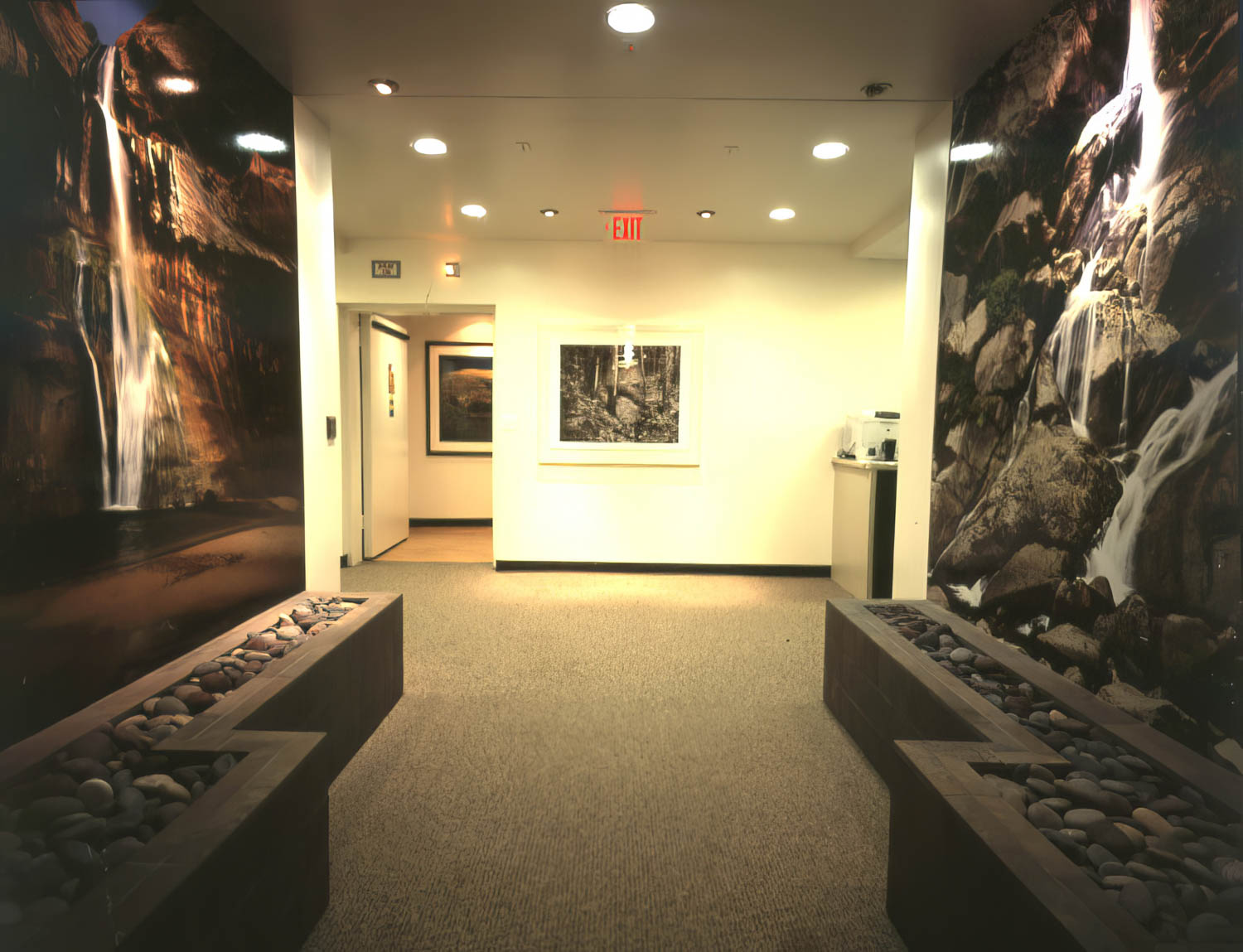
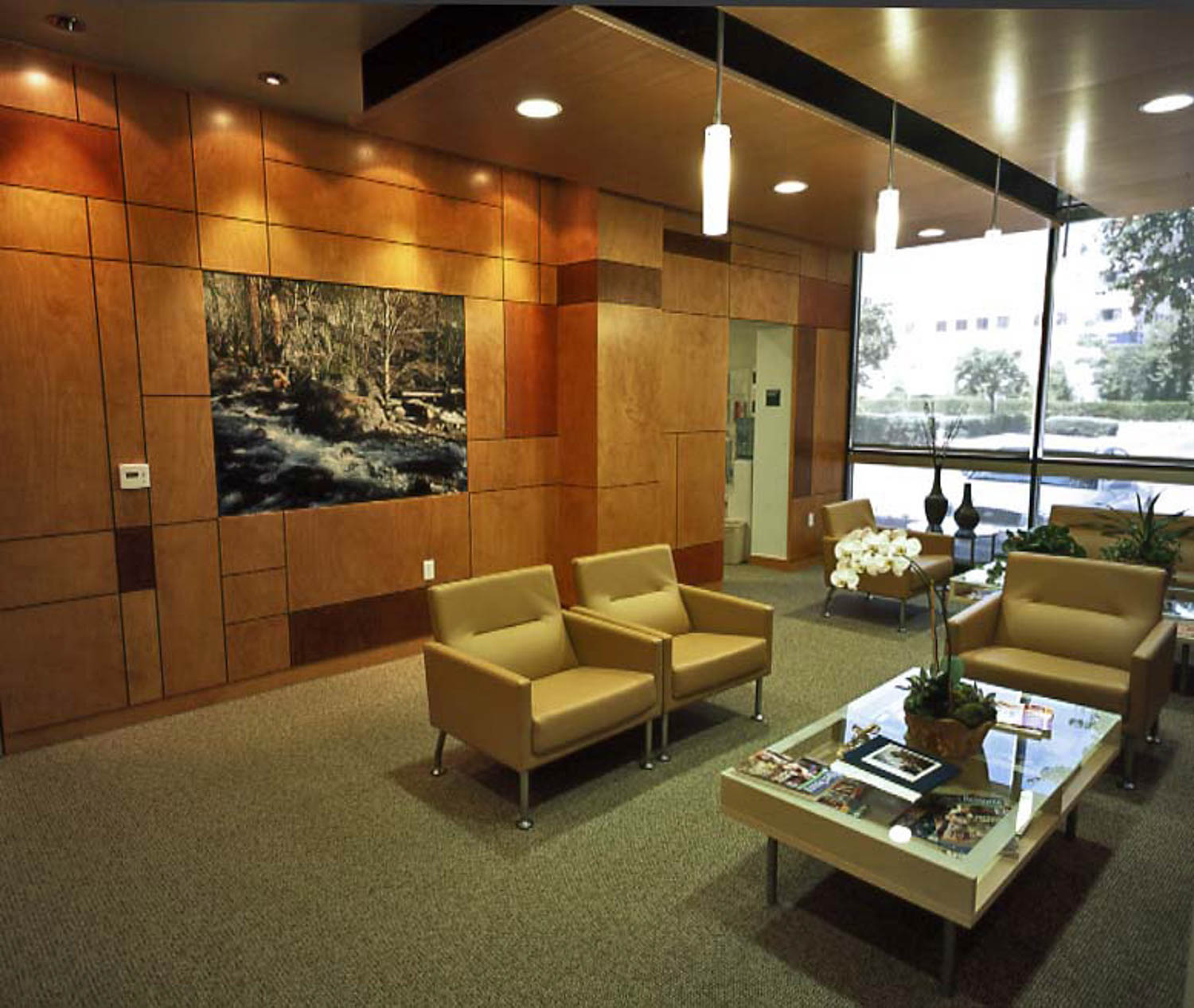
Fortunately, when I was with Vantage Oncology that took over part of my practice or the technical component, we built the West Hills facility and they let me work with the architect to put art. So the theme that I had was, it’s an art gallery where you just happen to get radiotherapy.
Stacy Wentworth: I love it. I love it.
Bernie Lewinsky: We had to build the vault outside the building and so we had to connect it. So in the passageway between the old building and the vault, I put in these floor-to-ceiling waterfalls and I put troughs with rocks in them and little fake plants and a sound of rain and water.
There was a transition that the patient had to go through to get to the vault that just took their mind off the treatment. I have to say that I’m very honored, the California Hospital, they built a new Women’s Center and in the center of the old hospital and the new hospital is a little courtyard and they’re naming it Dr. Lewinsky’s Healing Garden.
Stacy Wentworth: Wow. What a tremendous memory. That is fantastic. What an honor.
Bernie Lewinsky: Yeah.
Stacy Wentworth: That’s a wonderful approach to just think about what the patient … To us, we’re going to work every day, but that’s the patient’s first experience with something as horrific and as life changing as cancer.
Bernie Lewinsky: I had patients that were upset that their treatment finished because the half an hour of waiting or whatever time was the time that they could sit and relax and just calm.
I’m trying to write a book correlating all of that. It will get done I hope before I go, but anyway. It’ll be made for patients to understand.
Stacy Wentworth: We can’t wait to read it. I think that there’s so much wisdom there and the patients are ultimate teachers, right? They’re learning from us and sometimes I feel like I come home during the day and I’ve learned more from them, so yeah.
Bernie Lewinsky: Yeah.
Stacy Wentworth: Well, thank you, Dr. Lewinsky, for your time. We really appreciate you sharing all of this with us, and of course, such a fascinating history of radiation oncology encapsulated in a single person’s career. It’s just absolutely mind-blowing. Thank you so much for being with us.
Bernie Lewinsky: My pleasure. Thank you.
Katie Goldberg: The Cancer History Project is an initiative of The Cancer Letter, the leading source for information on the issues that shape oncology since 1973.
Learn more and explore our archives at cancerhistoryproject.com.