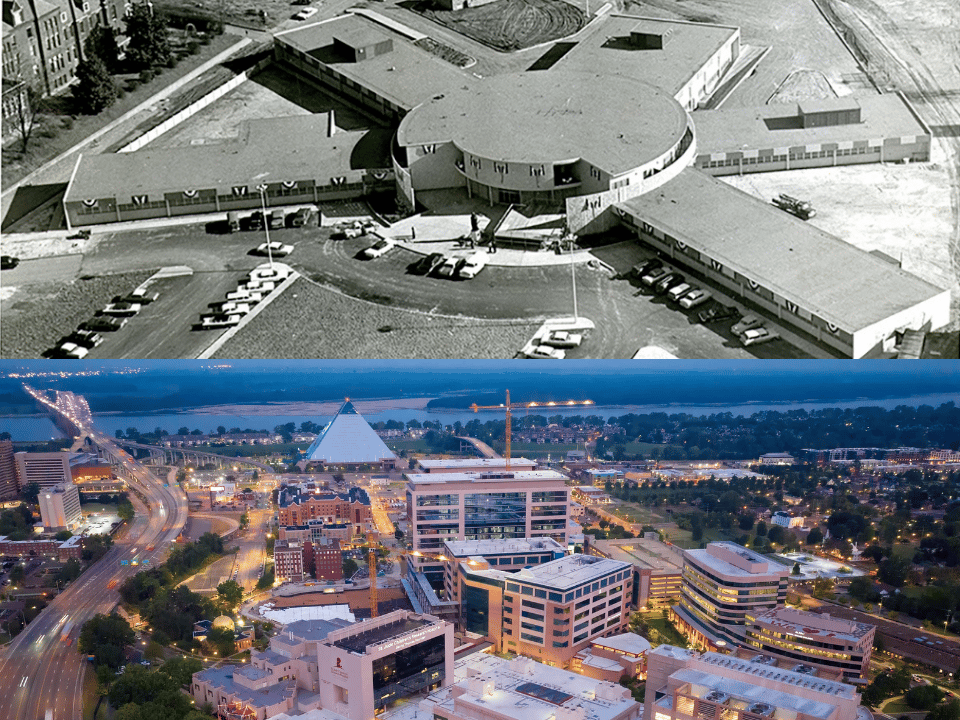
“Backwater to Blockbuster,” the first de novo book published by the Cancer History Project, traces the evolution of St. Jude Children’s Research Hospital to its current status of a powerhouse of research in pediatric cancer.
The book is available at no charge on the Cancer History Project website.
In a conversation moderated by Deborah Doroshow, the book’s co-authors Charles J. Sherr and William E. Evans discuss how their book project began, and their collaborative writing process.
As long-time leaders, Sherr and Evans were a part of the institution’s rise and thus speak authoritatively about the institutional culture, leadership philosophy, and scientific ambition that shaped St. Jude.
Sherr, who joined St. Jude in 1983, served as chair of Tumor Cell Biology Department and Herrick Foundation Endowed Chair at St. Jude. Evans first came to St. Jude as a student in 1972 and served in many key positions including that of St. Jude’s fifth director and CEO.
Doroshow, a medical historian and an associate professor of medicine at the Tisch Cancer Institute at the Icahn School of Medicine at Mount Sinai, guides a podcast discussion exploring how Sherr and Evans approached the story of the rise of St. Jude from their different professional and personal perspectives, ultimately coming together to co-author a dual memoir and institutional history.
The project began during the COVID-19 pandemic, when Sherr started writing what he initially intended to be a memoir. Encouraged by a scientific publisher to focus instead on St. Jude, he turned his attention to the institution’s history.
After coming to St. Jude from NCI, Sherr played a central role in building the Cancer Biology Program. Sherr’s research is focused on oncogenes and tumor suppressors, mechanics of cell division cycle control, and perturbation of cell cycle regulators in cancer.
He is a member of the National Academy of Sciences, a fellow of the American Academy of Arts and Sciences, American Association for the Advancement of Science, and the American Association for Cancer Research. He has won the AACR Landon Prize for Basic Cancer Research and the Pezcoller Award as well as the General Motors Cancer Foundation Mott Prize.
At the same time as Sherr, Evans, a clinical pharmacologist and the director and CEO of St. Jude from 2004 to 2014, a faculty member in pharmaceutical sciences, and pioneer, together with his spouse Mary Relling, in developing the field of pharmacogenomics, had independently begun writing his own history of the institution.
Evans initiated and chaired the St. Jude Department of Pharmaceutical Sciences, and from 2002 to 2004 served as the hospital’s scientific director and executive vice president. He also currently holds the St. Jude Professorship and Endowed chair at the University of Tennessee College of Medicine and Pharmacy.
He is a member of the U.S. National Academy of Medicine, and the German National Academy of Sciences.
For the past 40 years his research has focused on the pharmacodynamics and pharmacogenomics of anticancer agents in children with acute lymphoblastic leukemia, for which he has received three consecutive NIH MERIT Awards from NCI. Evans is a past recipient of the Volwiler Award from AACP, the Pediatric Oncology Award from ASCO (with Mary V. Relling of SJCRH), the Team Science Prize from AACR (shared with SJCRH colleagues), the Remington Medal from APhA, and the Oscar B. Hunter Award from ASCPT.
As Sherr and Evans compared notes, they realized that their perspectives complemented one another and decided to merge their efforts into a single narrative.
“So, we came at the book from different points of view, and as we shared our stories, we realized that there were some interesting parallels, but also personal perspectives that added color to the story,” Evans said. “That’s how it started.”
The book soon evolved into a first-person, dual memoir and history, emphasizing personal experience rather than an objective historical account.
“It’s important to note that Bill joined St. Jude 10 years before I did, and so, he was the ideal teller of the earlier history, from a very personal point of view. I think what evolved was a series of personal recollections from our histories rather than an attempt to write an omniscient third-person narrative,” Sherr said.
The idea of writing the book from a first-person perspective came from Paul Goldberg, editor and publisher of The Cancer Letter.
“It wasn’t until Paul Goldberg actually saw an early draft of what we had written that he came forward and said, ‘Look, write this in the first person.’ That crystallized the directions that we ultimately took,” Sherr said.
In addition to offering editorial advice, Goldberg said that The Cancer Letter’s Cancer History Project would be able to publish the book and make it available at no cost to readers.
The Cancer History Project, which was started in 2021 to commemorate the 50th anniversary of the signing of the National Cancer Act, has published several books, with the objective of making them once again available to wide audiences.
These include:
- Joseph V. Simone, “Simone’s Maxims: Understanding Today’s Medical Centers.”
- John Laszlo, “The Cure of Childhood Leukemia: Into the Age of Miracles.”
- Richard A. Rettig, “Cancer Crusade: The Story of the National Cancer Act of 1971.”
- Shirley Haley, “Angel in Mink: The Story of Mary Lasker’s Crusade for Medical Research and the National Institutes of Health.” The book was sponsored and produced by Act for NIH and is distributed in the electronic format by the Cancer History Project.
“Backwater to Blockbuster” becomes the first book edited and published by the Cancer History Project.
As Sherr and Evans experimented with Goldberg’s editorial suggestion, the writing became more personal.
“I thought the book became more intimate as we went forward, and I’m happy to say that it expresses our personal opinions and our experiences, and it’s not an attempt to be anything else, other than sharing what we experienced, each of us over our many years there,” Sherr said.
The story Sherr and Evans tell is, in many ways, an improbable one.
In the early 1960’s, St. Jude was founded in Memphis, Tennessee, a place that at the time was not considered a major academic hub. During that era, childhood leukemia survival rates hovered around a 4% five-year survival rate.
The institution also committed itself from the outset to racial inclusion during segregation, and provided free care to all patients, regardless of background or ability to pay.
Spawned literally by the vision of the entertainer Danny Thomas, the hospital grew from a small and unconventional experiment into the largest medical charity in the U.S. and the only NCI-designated Comprehensive Cancer Center devoted solely to children.
Thomas founded the hospital to fulfill a vow he made to St. Jude Thaddeus, the patron saint of hopeless causes. While a struggling entertainer in the 1950s, Thomas promised to build a shrine if the saint helped him find success. After achieving that success in television, he founded the American Lebanese Syrian Associated Charities to raise the necessary funds from supporters and donors.
“Memphis was a segregated city. It was a Jim Crow city when Danny established the first interracial, intercultural hospital scene in Memphis,” Sherr said. “I mean, that was a huge step forward, right? This was years before Martin Luther King was assassinated in ‘68. The hospital opened in ‘62, and this was an amazing thing to do. And so, if you were betting that a hospital for children of all races would prosper in Memphis, Tennessee, what would be your bet? So, I think that in itself was extraordinary. Absolutely extraordinary.”
Its success was therefore highly unlikely.
“I mean, if you were a betting person, you wouldn’t go all in on the idea of this institution,” Sherr said. “St. Jude has a distinct origin story.”
The book traces St. Jude’s transformation through the eyes of two people who helped shape it—from the hospital’s early struggles to its scientific breakthroughs, including pioneering clinical trials that contributed to the first cures for childhood acute lymphoblastic leukemia and advances across pediatric oncology.
“It’s a behind-the-scenes look at how the organization evolved and many of the obstacles it had to overcome,” Evans said. “Millions and millions of people in the U.S. have heard about St. Jude, but they’ve heard the story about patients and successes and accomplishments, accolades, and they haven’t really seen the struggles behind the scenes that occur at any organization that is trying to be innovative, trying to do something no organization’s ever done.
“You’re going to have challenges along the way and have to face obstacles,” Evans said. “And to us, it was interesting how we addressed and overcame those. And I think this could be interesting to others, people who are trying to launch new organizations. It doesn’t have to be a cancer program or a pediatric hospital. It could be any kind of new organization being launched. A startup is going to have challenges.”
Now, the St. Jude and ALSAC Boards of Directors and Governors function as volunteer-led governing bodies that provide strategic oversight, financial management, and policy approval for the hospital and its fundraising organization. They ensure the mission to cure pediatric cancer is met, managing a billions-dollar budget while keeping free care for families.
According to a combined financial statement by St. Jude and ALSAC, the revenues, gains, and other support totaled $3.79 billion in fiscal year 2024, the most recent year for which these numbers are available.
That sum is equivalent to 52% of the 2024 NCI budget and is 4.5 times higher than the revenues, gains, and other support reported by the American Cancer Society that year.
“We do speak about the board and its governance role at St. Jude periodically throughout the book,” Evans said. “Sometimes we’re unhappy with the board; sometimes we’re saved by the board. It is an interesting board—they’re amazing. They’re too big. They’re 50 people, roughly, but they’re all enormously dedicated, and they all do things like pay their own travel, their own housing. They each raise a million dollars a year on average for the organization.”
In the early days of St. Jude, the board contributed a lot of services to the organization, including legal and business expertise, because St. Jude had no lawyers, he said.
The conversation with Doroshow also turns to leadership philosophy and mentorship, including the culture of collaboration cultivated at St. Jude.
“One of the things I’ve learned, fortunately early, and I passed on to many of my postdocs and junior colleagues over the years, is when you’re engaging in a collaboration on a project, first of all, I encourage them to think about collaborators, and St. Jude certainly encourages that, but then I encourage them to go after the strongest person in that area to collaborate with,” Evans said. “Don’t go after the nicest person, the kindest person necessarily. They may have those traits, they may not, but if they’re the best scientist in genomics or in tumor cell biology, whatever, those are the people you want to work with. When I put my senior management team together at St. Jude, I didn’t pick my friends to be on that team.”
Sherr reflected on how institutional wisdom and leadership “maxims” are often borrowed, adapted, and passed along through generations of scientists and administrators.
“I have a maxim where I tell people working in the lab, ‘Fast is slow, and slow is fast,’” Sherr said, explaining the importance of building research on a rigorous experimental foundation rather than rushing toward results. “I realized years later that ‘fast is slow and slow is fast,’ which I thought was my idea, really comes from a guy named Steve Covey, who has written about human behavior. And in researching it myself, I was embarrassed to see that there was essentially the same maxim put forward years before by someone else. So, I think it is common that we hear things that we like and they become part of our lexicon along the way.”
This episode is available on Spotify, and Apple Podcasts.
The Cancer History Project Podcast is sponsored by City of Hope, the American Society of Clinical Oncology, the Sidney Kimmel Comprehensive Cancer Center at Johns Hopkins, and the University of Texas MD Anderson Cancer Center.
St. Jude archives:
- James Downing to step down as president and CEO of St. Jude to focus on global pediatric medicine, The Cancer Letter, Feb. 20, 2026
- Dwight Tosh, the 17th patient at St. Jude, on surviving lymphoma in 1962, The Cancer Letter, Sept. 16, 2022
- St. Jude’s $11.5B, six-year plan aims to improve global outcomes for children with cancer and catastrophic diseases, The Cancer Letter, May 14, 2021
- Donald Pinkel, St. Jude founding medical director who brought the word “cure” to cancer, dies at 95, The Cancer Letter, March 18, 2022
- Carlos Rodriguez-Galindo: St. Jude’s new platform is designed to become global authority on disparities in drug access, The Cancer Letter, Jan. 28, 2022
- Working in concert with NCI’s $500M data federation in childhood cancer, St. Jude demonstrates utility of its genomic database, The Cancer Letter, March 12, 2021
- St. Jude colleagues remember Joe Simone, The Cancer Letter, Jan. 29, 2021
- Book: Simone’s Maxims: Understanding Today’s Academic Medical Centers
Episode transcript
Charles J. (Chuck) Sherr: Yes. I started writing a memoir after the pandemic, which had forced me to stay home. I had shared it in a preliminary form with John Inglis, who is the executive director of Cold Spring Harbor Press. I had been on the laboratory board for several years, and so, I knew John and asked if he’d read the memoir and give me an opinion about whether any of the stories were publishable. He suggested that a book about St. Jude might be interesting to people, so spurred on by that, I called Bill Evans and asked him some questions.
Wiliam E. (Bill) Evans: Well, Chuck asked me for some details about the early days before he joined St. Jude, and coincidentally, I had also been writing a history of St. Jude from my perspective, thinking it needed to be recorded somewhere. And when Chuck started asking me questions, as we were chatting through the email and phone, I said, “Well, let me just send you a document. So, I sent him a chapter from what I had written. He said, “What else have you got?” And then we realized that we were both recounting the history of St. Jude from slightly different perspectives, and that it might make sense if we combined our efforts and tried to meld this together into a story about the history of St. Jude as we had seen it, both of us having worked on the faculty for many years. I think if you add the number of years we’ve each worked there, it almost reaches 90.
So, we came at the book from different points of view, and as we shared our stories, we realized that there were some interesting parallels, but also personal perspectives that added color to the story. That’s how it started.
WEE: It might’ve been months into this conversation before Chuck said, “Well, why don’t we combine our efforts?” And even though Chuck and I had been on the faculty there for decades, we had only written one paper together in our entire history of doing research at St. Jude, and that was a paper led by someone else to which we both contributed. I didn’t know exactly what I was getting into <laugh> writing a manuscript, or in this case, a book with Chuck. But I knew that he was a very insightful, brilliant guy, not an easy dance partner, but one that I thought would be worthwhile giving it a shot, so I did. It was a bit of bravery on my part. Don’t you think, Chuck? <laugh>
CJS: Nicely said, Bill. <laugh> Maybe I should just leave it at that. <laugh> I do like to write, and I am probably a difficult taskmaster when it comes to writing. Bill and I traded essential information back and forth, which was ultimately crystallized into chapters that were arranged in chronological order. It’s important to note that Bill joined St. Jude 10 years before I did, and so he was the ideal teller of the earlier history, from a very personal point of view. I think what evolved was a series of personal recollections from our histories rather than an attempt to write an omniscient third-person narrative. This was probably implicit in the way we went about it, but it wasn’t until Paul Goldberg actually saw an early draft of what we had written that he came forward and said, “Look, write this in the first person.” That crystallized the directions that we ultimately took.
WEE: Well, I was going to say, the other interesting thing is I came into St. Jude as a student, and Chuck came into St. Jude a decade later as a big shot. He was a department chair, had already launched a very successful scientific career, and I was just growing up during the first decade that I was at St. Jude. The other thing this partnership did, although I like to write as Chuck does, was that Chuck might read some of my passages and say, ”You know, Bill, that’s the wrong tone.” Or he might even say, “Bill, that’s the wrong content. I understand where you’re coming from here, but that may not be a good thing to place in this book.” And then there would be things Chuck would write that I might say, “You know, maybe it’s better if I tell that part of the story instead of you, and we might move content from one person’s point of view to another.” But it was very congenial, and I think an effective partnership where we became each other’s critics in terms of what we were trying to say and how we were trying to say it.
CJS: Yeah. From my point of view, it was a very enlightening experience. I learned things along the way from Bill that I hadn’t known, maybe vice versa. I thought the book became more intimate as we went forward, and I’m happy to say that it expresses our personal opinions and our experiences, and it’s not an attempt to be anything else, other than sharing what we experienced, each of us over our many years there.
WEE: I’m sorry, Deborah, but I, you know, I think it’s a fascinating story, and it’s a story some of which hasn’t been told, hasn’t been communicated publicly. It’s a behind-the-scenes look at how the organization evolved and many of the obstacles it had to overcome. Millions and millions of people in the US have heard about St. Jude, but they’ve heard the story about patients and successes and accomplishments, accolades, and they haven’t really seen the struggles behind the scenes that occur at any organization that is trying to be innovative, trying to do something no organization’s ever done. It’s not going to be a straight-up trajectory. You’re going to have challenges along the way and have to face obstacles. And to us, it was interesting how we addressed and overcame those. And I think this could be interesting to others, people who are trying to launch new organizations. It doesn’t have to be a cancer program or a pediatric hospital. It could be any kind of new organization being launched. A startup is going to have challenges. And one can learn from how other organizations overcame those types of challenges in building a new company or new hospital or institute or whatever.
CJS: I would say we were worried about how to discuss matters. I think Bill summarized perfectly that the book is intended to discuss how St. Jude overcame significant obstacles and how it took advantage of emerging opportunities, some of them quite unexpected, and how, in telling this story, there are probably some controversial aspects … I think the book is largely celebratory, but there are probably some aspects that could appear to be too critical, and we were concerned about those, because we both love the institution and have no desire to change the public’s perception. St Jude is a major charity, and so, we had concerns and had a lot of discussion about these between us. But having said that, we did not share the book with anyone. I think it’s fair to say we kept it as a confidential piece between the two of us. Is that fair, Bill?
WEE: That’s absolutely fair, Chuck. I think we individually may have touched base with people who were part of the story to make sure we’re getting the narrative correct, but we weren’t trying to make this a PR piece. As you know, we have a major fundraising organization that is spectacular, and we didn’t want to do anything that would do harm or damage what they’re doing, but as Chuck said, they don’t tell the behind-the-scenes story. They tell about our successes, future plans, and where we’re heading, and the book is intended to look inside the organization more deeply at how it accomplished what it did, and where it succeeded, and where it failed, and how we overcame those failures.
CJS: Yeah, that’s true.
CJS: I think that’s in the prologue.
WEE: <laugh>
CJS: Yes, a lot of it is right up front. I think the first sentence is, if you were a betting person, you wouldn’t go all in on the idea of this institution. I mean St. Jude has a distinct origin story. It starts with Danny Thomas and ideas, ones that people thought were never going to be realized.
WEE: Yeah. I tell the story … I have told the story many times about Danny having a crazy business plan where he picked childhood cancer as the focus of the organization, which was a death sentence in the early 1960s. Cure rates for leukemia were 4%. The second thing he did was he put it in Memphis, Tennessee, which, as we say in the book, was not exactly a hotbed of academic medicine then, nor is it really today, other than, you know, St. Jude and a few programs at the university. The other thing he did in his business plan was to say, we’re going to make it open to all children of all races, colors, and creeds, and that was particularly unusual in the ’60s. And the final pillar of his business plan was that we’re not going to charge for care.
CJS: I don’t mean to interrupt, but Memphis was a segregated city. It was a Jim Crow city when Danny established the first interracial, intercultural hospital scene in Memphis. I mean, that was a huge step forward, right? This was years before Martin Luther King was assassinated in ‘68. The hospital opened in ‘62, and this was an amazing thing to do. And so, if you were betting that a hospital for children of all races would prosper in Memphis, Tennessee, what would be your bet? So, I think that in itself was extraordinary. Absolutely extraordinary.
WEE: Yeah. And the final pillar of his business plan was, “We’re not going to charge anyone for anything. We’re going to do it for free.” Now, who would predict that this business plan would work, right? Yes, for all those reasons, but it did, and it worked spectacularly, and it’s interesting how it came about and how it succeeded, and that’s what the book is about.
WEE: I’m sorry, Deborah, … I need you to clarify that. You’re talking about these two objectives of the organization being treatment and research?
CJS: Well, initially, it was going to be St. Jude Children’s Hospital.
CJS: And it was Don Pinkel, who was the first medical director, not the CEO, or at least not formally CEO when he joined the organization, who changed the name. He was 34 years old, came from Roswell Park, had interests in leukemia, and in consultation with local people at the University of Tennessee in Memphis, decided that leukemia and hematological diseases like sickle cell anemia would be a good place to start. But he also did something that was very original, and that is, he added the term “research” to the name of the hospital. It became St. Jude Children’s Research Hospital, and that was Pinkel’s inspiration. It was his strong view that you could not make progress in medicine unless you had a research institute, and so he decided that he would employ scientists as well as physicians, and that’s been true from the beginning. Putting those two arms of the institution together has always been a challenge.
There have been times when the clinical side trumped the other in dictating direction and future planning. There were also times when the perception was that St. Jude had to dedicate more resources to research to drive medical progress. And so, those two things went hand in hand, but there was always a bit of tension between how much of each should be the focus. And of course, St. Jude is best known for the vision to advance cures in children with catastrophic disease. That’s always been the case. But people who do scientific research don’t necessarily think that way. Hence, there can be a conflict. You know, people who do academic research are interested in questions that may have nothing to do with patient care or nothing to do, at least in principle, with the mission of the hospital.
And so how do you blend those two things together? That ultimately becomes the charge of the director and CEO. Pinkel started that. Bill had to do that when he was in charge of the place as a CEO. Joe Simone, who was CEO between Pinkel and Bill played an enormous role in trying to link research with medicine. And when I joined the institution in 1983, it surprised me how much Joe wanted to develop the research arm of the hospital and how much support he gave us in recruiting scientists. It was a big surprise. He was a card-carrying adult and pediatric physician. He had developed the first clinical trials together with Pinkel. He was not a researcher, but what was incredible about Simone was how much support he gave to developing research at St. Jude. He had an enormous footprint.
WEE: Yeah. If you look at the budget over the decades of St. Jude, it’s almost always been pretty equally divided between patient care and research. That’s about the same amount of money being spent on each. And on the research side, that’s divided into clinical and basic research. So, we have the diseases we’re pursuing and the treatment protocols we’re conducting. On the basic science side, we carefully select the disciplines in which we want to recruit scientists. Chuck was brought in to start tumor cell biology before basic cancer biology was a focus. In general, once we recruit a new chair, he or she is then charged with recruiting faculty. And in recruiting basic science faculty, you’re recruiting people that you think have talent and have a program that’s headed in a strong direction, but the institution never told those basic scientists what to work on. We didn’t say, you’ve got to work on leukemia, you have to work on brain tumors. The department chairs recruited into those disciplines – it could be neurobiology, hematology, genetics, immunology, et cetera.
So, in that way, it was much like a university where you’re not telling your faculty what to work on, but they’re embedded in an organization that takes care of patients, and they may see those patients every day. Sometimes scientists had to walk through the waiting room to get to their laboratories. There was one period of time when that was literally true. From the very beginning, basic scientists were having lunch in the cafeteria with patients and families, and they might have a kid with an IV and a bald head sitting next to them as they’re having lunch. Don Pinkel’s idea that Danny embraced would be having everybody together in that cafeteria, whether they were visitors, or basic scientists, or clinicians, or patients, or family. And I think that was originally a constant message to our faculty about why we were there, even though we weren’t saying, “Do neurobiology that’s related to brain tumors.” The reality is that you don’t know where the breakthrough is going to come from in terms of basic science that will ultimately drive a change in the treatment of brain tumors or leukemia. You can’t structure the research in that way.
You know, people used to ask me while I was serving as CEO, “What do you do at St. Jude?” And I said, “Well, it’s pretty simple. I do what I can to help recruit the best and brightest people, and then I try to make St. Jude a place where they can do their best work, and I stay out of their way.” How do you do that? You create programs, you create shared resources to help their research, but you also create a culture, a culture of collaboration and innovation, a culture of quality, a culture of compassion for the patients. Those are subtle things. I mean, we certainly had strategic plans for the organization every five years, but I often said that culture trumps strategy.
You can have a great strategy, but if you put people in the wrong culture, they’re not going to be as successful as they would otherwise. And so, you know, Chuck worked on that in his department and in the basic science side of the organization. Chuck was the first prominent scientist who was recruited to St. Jude, and then he helped recruit other prominent scientists. We talk about that in the book. Our friend and mentor, Joe Simone, used to say, “First-rate people recruit first-rate people, second-rate people hire third-rate people.” So, Chuck was always carrying the banner of, you know, “Here’s what a first-rate person looks like as a scientist in this field, and this is what we’re going to go after, and then we’re going to support them to do their best work.”
CJS: That’s a great, great question.
Yeah. I think I learned something very interesting. Joe was the person who hired me. I mean, he visited Bethesda. I was still at the NIH, and he was the one who convinced me to seriously consider coming to St. Jude. And as a New Yorker and then a Washingtonian, the idea of moving south was preposterous at the beginning. But I have to say that when I got there, I realized that recruiting investigators to my department, which was new, was not the job. With Joe, the job was getting other people like me to come to the institution and do what they wanted to do. My department was very, very small, particularly at the beginning. I gave joint appointments to a few people, one of whom was Jim Downing, who later replaced Bill and became the president and CEO. I started to build a group that was interested in cancer biology and genetics.
But as time went on and with Joe’s encouragement, I was asked to recruit people who would run other departments and not have anything to do with what we were doing in tumor cell biology. The first person was Jim Ihle who came to run biochemistry, and then, after that, the chairs of immunology and genetics, and finally the brain tumor program and developmental neurobiology, and eventually Joe’s replacement, Art Nienhuis, and Michael Kastan to direct Hematology-Oncology. These recruitments had nothing to do with my department or what was my initial charge. They were directed to improve the breadth of scientific research at the institution and create an interactive culture in which the people who came bought into it the same way that I did. It worked very well. I thought it was a great opportunity.
CJS: I’m going to start with Martine, and then Bill can fill in with Mary. The experiences are sometimes the same and sometimes different. So, Martine came along with me. I was a department chair on day one when I joined, and Martine was a research associate working with me. She eventually joined the faculty, but there was a period of time when we had very few women basic scientists, and secondly, they were not treated equally or paid equally. It was a problem for Martine. I had no such problem because I started at the top as a department chair, but she started at the bottom as a research associate. And she had to make her way through the ranks during her career. Now, Martine is very successful. She’s now a member of the National Academy of Sciences and the American Academy of Arts and Sciences.
She’s done a terrific job, but for her to build a program was an entirely different experience and represented, in her case, overcoming some prejudices and obstacles that were significant. We discussed one of those in the book about when Martine came up for a promotion and was turned down, despite stellar references from extramural scientists. The people who did not want to promote her decided on their own that her contributions resulted from her collaboration with me, which was not true and unfair. They did not appreciate her for her own science because they couldn’t dissociate what she had done from what I had done. And of course, it was a conflict of interest for me to try to clarify that. And so, I was out of the loop.
I could say nothing. I just had to watch as she was mistreated. It took a while, I think, to overcome that past. And Bill, you might want to say some words about Mary.
WEE: Yeah. Well, first of all, Chuck, that passage about Martine’s situation with the faculty promotion committee was in my section of the book. <laugh>. I mean, we’ve written the book in separate sections, with separate voices, and we don’t remember who’s talked about what.
But, you know, I think the challenge for women at St. Jude is like it is anywhere else. When you’ve got a spousal unit that’s on the faculty, each member of that unit has to establish their own independence and their own independent program, if they want to make advancements in the academic hierarchy and get promoted as a faculty member. And so, that’s often a challenge. Chuck cast a big shadow for Martine to get out from under, and that was no simple task, but she did. And Mary was also quite successful. We worked in the same area, as Chuck and Martine did, so it makes it more difficult to create your own path and say, “This was my independent program,” when you’re in an organization that encourages collaboration, and you don’t want to push people apart who are synergistic in their science and their research.
But there are many examples now of where that’s been done successfully at St. Jude. Sometimes the woman is a stronger member of that pair, and sometimes it’s the man, and that’s the way it should be. I think a lot of biases have been eliminated, but they were there at the beginning. Mary went on to become a member of the National Academy of Medicine, so she carved her way and was successful. I like to think St. Jude helped each of them, as it did Chuck and me. Our spouses were in an environment where they could follow their own path and get support from the institution to make their research as strong as it could be.
CJS: One little anecdote in Martine’s case. It was the recruitment of Tom Curran to start a new program in developmental neurobiology that offered Martine a scientific direction that was quite independent of what she had done with me and helped her establish a program that was directed toward understanding the formation and treatment of brain tumors, where she’s made a mark. And that has absolutely nothing to do with me. The opportunity to do that resulted from the recruitment of Tom Curran to run the developmental neurobiology program. That’s an example of how individuals could take advantage of emerging opportunities in the institution that were not necessarily planned out from the beginning.
WEE: Right. Becoming scientific director and then CEO pulled me away from my focus on my research and cleared the path for Mary to take over and run with it and be quite successful without me. And that was good for the organization, just as was Martine becoming part of the scientific foundation for our brain tumor program. You may have realized in reading the book that when we developed a clinical program, we wanted to have at least one, maybe multiple, basic science departments that would provide a foundation for that. And when we started the brain tumor program in 1984, we didn’t yet have that basic science foundation. And it was only, I think, many years later, when Chuck recruited Tom Curran and Jim Morgan to come and establish a Department of Developmental Neurobiology, that spurred new ideas, advanced the science, and led to better ways to diagnose and treat those diseases.
WEE: Well, becoming a department chair happened a few years after Chuck arrived. And that was my first formal leadership responsibility. But, actually, Chuck played a role in my becoming scientific director when Art Nienhuis had been recruited to St. Jude by Chuck to be the new CEO. Art came out of the NIH, so he had never written a grant. He had never had to write an RO1 or a cancer center grant. And when it came time to write the cancer center grant, Art needed some help. He went to Chuck and said, “Can you help me? ” He knew Chuck was a good writer and a good grantsman, and Chuck said, “I’ll be happy to help.” But he sent Art to me.
CJS: <laugh>
WEE: Yeah. He said Bill’s good at writing grants and he’s willing to do so.
CJS: Bill had one MERIT award after another. And I said, “I can’t do this.” I was working at the Howard Hughes Medical Institute as an investigator. I would’ve had to give it up. I said, “Go see Bill.”
WEE: It was a thousand-page grant back then; now, it’s a couple of thousand pages. Art approached me and had been CEO for a couple of years by the time this grant came up for renewal. I really hadn’t spent much time with Art. I was on the executive committee, and I came and went and made contributions, but I went back to my department and my research, and I didn’t make special appointments with Art to educate him about what I was doing or where we were going. But when I began working with him on this grant, now suddenly we were working every day side-by-side, shoulder-to-shoulder, putting this grant together, and we got to know each other. And at the end of that process, which took about nine months, he asked me to be deputy director of the cancer center.
In that capacity, we began to work more closely together. He began to take me to board meetings. That exposed me to the board and vice versa, because I think it was a few years later, when Chuck was leading the search committee for Art’s replacement, my name came up. At that point, the board knew me. Had I not been going to board meetings with Art for two or three years, I would have been a complete unknown to them, and I doubt I would have gotten the opportunity to do that. So, I think it was serendipity along the way and sort of staying focused on really why I was there in the first place, which was my science and my contributions to clinical trials, and not trying to become CEO.
I never had that in my game plan, but when those opportunities came along, for some reason, I felt comfortable doing it. And like I said in the book, I never took a finance course. I never took a leadership course. I never took a management course, and yet I was being asked to run an organization at the time that was, I don’t know, $400 million a year in budget.
WEE: Right. Which was a big deal. And I think, again, if the board hadn’t known me, and hadn’t heard me speak about clinical trials, translational research, and not just basic science, they may not have had a comfort level with me of doing the job. We made the point in the book that St. Jude has never been led by anyone other than a doctor or scientist. We’ve never had a business person as a CEO. We’ve never had a lawyer. We’ve never had anyone other than a scientist or physician. And I think that says a lot about the organization. The person leading our programs is not trying to make us profitable. They’re not trying to grow the business, if you will. They’re trying to advance the science and advance treatment. And I think that’s still the case, and I believe it will continue to be the case in the organization.
CJS: The first great example was this offer to move the entire institution to St. Louis and to become a part of Washington University Medical Center. That is a chapter that is discussed separately. Initially, there was tremendous enthusiasm for the idea because Wash U. had already developed into a major medical center. They were building a new children’s hospital, and they had a lot of academic excellence, which was not available to us locally in Memphis. They had a stellar medical group that could have helped us with our patients in a brand new children’s hospital. The initial idea looked really rosy, and it only became a problem as we got into the nitty-gritty of talking about how to blend two organizations with different cultures into one. And finally, it became an impossibility.
I think the underlying issue there was that people are very selfish. Their primary concerns are to protect their own prerogatives and territory, and it’s just a facet of human nature that eventually you’re going to face the question of, If we take this person into the university, who is he/she going to work for? How is he/she going to fit with our establishment? Where is St. Jude money going to go? Are we going to adjudicate expenditures, or are they going to be entirely separate? Will they have a separate unit in the hospital? All these questions bubble up to the surface. Meanwhile, you’re under enormous pressure because by the time the information becomes public, you have senators and governors, local newspapers, the national press, and the New York Times commenting, and you’re under a lot of pressure.
And I think finally, the board made the right decision. It was not the decision that we were looking for at the beginning, but it was the right decision at the end, and that was not to lose control of the organization; to not give away any aspect of what had been established before; to maintain the culture that had been established to that point. The board turned to the leadership (Simone was still director) and said, I think for the first time, “Draw up a strategic plan that allows you to stay where you are in Memphis, Tennessee, but create an environment that you think you need to prosper.” At that point, the board committed an enormous amount of money to the hospital. It was the first time they decided to build a new building or buildings.
They committed to building a new hospital. They committed to building a new science research center, which was named the Danny Thomas Research Center. It was an amazing sea change on the part of the board. And I think the Wash U. experience turned out to be a really great thing for St. Jude, even though at the beginning, I personally thought moving up there would be a great solution to some of our problems. It turned out that the board was prescient in keeping control of the institution, and in doing that, they kept control of the values and culture of St. Jude.
WEE: This brings up the topic of our board, and we do speak about the board and its governance role at St. Jude periodically throughout the book. Sometimes we’re unhappy with the board; sometimes we’re saved by the board. It is an interesting board – they’re amazing. They’re too big. They’re 50 people, roughly, but they’re all enormously dedicated, and they all do things like pay their own travel, their own housing. They each raise a million dollars a year on average for the organization. And in the early days of St. Jude, they contributed a lot of services to the organization, because there were no lawyers at St. Jude, and we needed legal work done. One of the board members was a lawyer, or two or three of them were, and they also offered business expertise in the early days to help run the institution.
They’ve evolved as we’ve evolved as an organization, so we now have our own internal capacity to do the management, yet they tend to still hang on to some of that desire to help manage the organization. But in the example of the Wash U. situation, I agree with Chuck. I think they made the right decision because we would likely have lost our identity as a freestanding institution and charity, and they saw that, and they voted it down, and they’ve done that on some other occasions as well. But what they’ve always done when they did that was they’ve come back to the leadership and said, “So what do you need to address the problem that made you propose to move to Wash U. or to move the general children’s hospital in Memphis closer to our campus? Why did you want to do that? And how can we help you fix it? “
They would put up resources for us to deal with the problem that had driven us to want to do something they couldn’t approve. And in the case of Wash U., I think being embedded in a campus like that in a top 10 academic medical center, where there’s strong basic science, was very attractive to people like Chuck and other basic scientists who wanted to be surrounded by other top-quality scientists. And the board said, “Well, okay, we will fund you to grow the basic science programs at St. Jude to add new departments and to address that situation in that way as opposed to moving elsewhere.” And they’ve done that kind of thing, put up new resources to address decisions they made that the management was not hoping to be the outcome, but it turned out to be fruitful.
It’s been a great give-and-take partnership between the leadership of the organization and the board. Some of the board members go back to Danny Thomas. They were there in the very early days of being involved in the organization, so they bring a history to their deliberations that most people don’t have for the organization.
CJS: Yeah, that’s very good. I have to say that all of Simone’s maxims didn’t necessarily originate with Simone. <laugh> They were adapted by his experiences, his global experiences with many others. The idea that first-rate people hire first-rate people was contributed by my stepmother, who ran circulations at Smithsonian Magazine. I told Simone that one day in his office, and he just loved it, and it immediately became part of his armamentarium of maxims. I do the same thing unwittingly myself. I have a maxim where I tell people working in the lab, “Fast is slow, and slow is fast.” And what I mean by that is you need to spend some time in creating a scientific effort where you ensure that you’re building on a firm foundation of experiments and thinking that makes sense, and that you don’t just skip over those while trying to get to a result.
But I realized years later that “fast is slow and slow is fast,” which I thought was my idea, really comes from a guy named Steve Covey, who has written about human behavior. And in researching it myself, I was embarrassed to see that there was essentially the same maxim put forward years before by someone else. So, I think it is common that we hear things that we like and they become part of our lexicon along the way.
WEE: Yeah. Joe had gravitas. When he put forward a maxim like that, people paid attention because Joe Simone was saying it in the Joe Simone style. But, you know, one of the things I’ve learned, fortunately early, and I passed on to many of my postdocs and junior colleagues over the years, is when you’re engaging in a collaboration on a project, first of all, I encourage them to think about collaborators, and St. Jude certainly encourages that, but then I encourage them to go after the strongest person in that area to collaborate with. Don’t go after the nicest person, the kindest person necessarily. They may have those traits, they may not, but if they’re the best scientist in genomics or in tumor cell biology, whatever, those are the people you want to work with. When I put my senior management team together at St. Jude, I didn’t pick my friends to be on that team.
I picked people who were bright and committed in their area. I had Jim Downing as my scientific director. I had Mike Kastan as my cancer center director. We liked each other and worked well together, but we didn’t go out drinking together, we didn’t play golf together, we worked together. If I’d wanted to have people who always agreed with me around the table, I would have chosen someone else. But I’ve always told my postdocs, “Go after the brightest and the best person to work with, wherever they are. They don’t have to be at St. Jude. They could be anywhere on the planet.”
WEE: Our pleasure.