
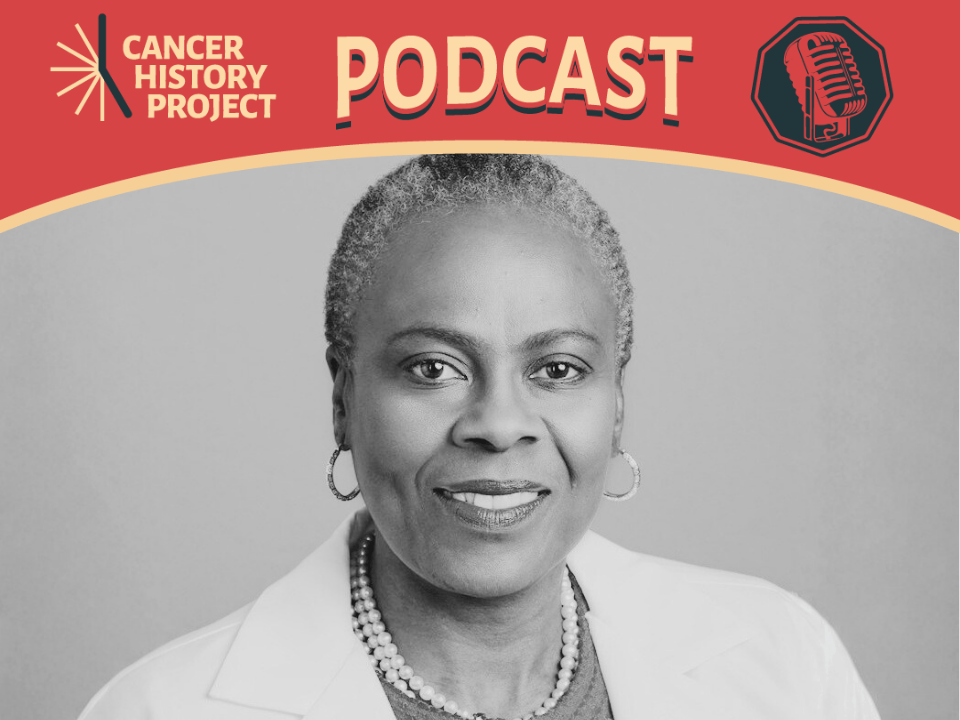
Olufunmilayo “Funmi” Olopade, director for the Center for Clinical Cancer Genetics and Global Health at the University of Chicago, credits her Nigerian upbringing for her focus on global cancer genetics.
“My Yoruba culture really worships our ancestors and the people before us,” Olopade said on the Cancer History Project podcast. “And so that’s why I was able to really say, ‘Okay, let’s lay the foundation for genetics. Let’s go to Nigeria.’”
Olopade appears on this special Black History Month episode of the Cancer History Project Podcast in conversation with Robert A. Winn, director and Lipman Chair in Oncology at VCU Massey Comprehensive Cancer Center and guest editor for The Cancer Letter for Black History Month highlighting some of the giants in the field of cancer research.
Olopade is certainly a giant in cancer genetics and global health.
“For those of you who don’t know, Dr. Olopade is not only the director of the Center for Clinical Cancer Genetics and Global Health at the University of Chicago, but she is really a giant in the field and internationally renowned in the context of her expertise in breast cancer,” Winn said on the podcast. “By the way, for those of you who thought you knew Dr. Olopade, remember that she is a really rare, not only National Academy, but in that top 1% of 1% of the 2025 MacArthur Fellowship, also known as the Genius Grant.”
On this episode of the Cancer History Project Podcast, Olopade shares her story of immigrating to the U.S. from Nigeria to pursue medicine, and finding her way to becoming a leading expert in oncology.
“For us to honor Black History Month, we have to honor all the people who mentored us, who were ahead of us,” Olopade said. “For me, my father was a pastor, and my parents really wanted a doctor. I had big brothers and sisters, I was number 5 of 6 children, and there was just one last chance to find a doctor in the family. Because in those days, growing up in Nigeria, you were either a teacher or a pastor, or and then in his generation he became a pastor.”
Growing up in Nigeria, Olopade was deeply influenced by the health disparities she saw due to lack of healthcare access, which initially sparked an interest in cardiology.
“So, coming to America, what I thought I was going to do was cardiology, because all I saw when I was in medical school were children with rheumatic heart disease,” Olopade said. “They had damaged their heart from not getting access to penicillin.
“Then I got to [Cook] County, and we were having people who had heart attacks. We were saving people in the critical care unit, and then we’re asking people to change their lifestyle. I thought, oh well, that seems solved.”
After pivoting to hematology and oncology, her focus on community drew her attention to the health disparities present among her neighbors in Chicago.
“That’s when we started talking about triple negative breast cancer,” she said. “Because if you just look at all the women who were walking into my door, why is it that these Black women were coming in with young onset, triple negative breast cancer, and no one was studying it?”
When Olopade first moved to Chicago, she had been advised to avoid living on the south side—a racially loaded monition common to Chicago, which is known for being heavily segregated. As a young mother, Olopade moved her family to the suburbs, but struggled with the commute to the University of Chicago, which is on the south side.
She credits her decision to move to Hyde Park, the neighborhood surrounding the university which is also famous for being home to Barack and Michelle Obama, as a source of inspiration for her research.
“When you have such greatness, when you have Michelle Obama and Barack Obama as your neighbors who are thinking about great things, you cannot but think about the community and that community influences you,” Olopade said. “All of them wanting to make the south side of Chicago the place to come to and, of course, the University of Chicago pushing us to do the best science. So, I’ve just been blessed, and that’s why when people ask me ‘why are you still in cold Chicago?’ I’m like, where else can I go?”
Both globally and at home, Olopade saw the impact of bringing research to the community.
“I’m not going to move the women on the south side out of the south side, but I’m going to take trials to them,” Olopade said. “I’m not going to move everybody out of Nigeria, but I’m going to take research to them, and I’m going to do clinical trials there.
“I kept telling people, you can’t all run out of Africa. We can’t forget that there’s so many billions of people on the planet who need our care. That’s why I became really passionate, and I’m so happy that they have named global research after you, Robert Winn, because you can bring the money. I just talk about it.”
This oral history interview is available on Spotify, Apple Podcasts, and YouTube.
Related articles
On Olopade’s mentors:
- Janet Rowley, cancer genetics pioneer, 1925-2013
- Harvey Golomb, past chair of UChicago’s Department of Medicine, dies at 82
- Cancer Luminaries Podcast: Dr. Otis Brawley Talks about Cancer Disparities as Barriers to Better Outcomes for All
Black women in oncology:
- Edith Mitchell on her path from Tennessee farm to becoming a cancer doctor and brigadier general
- Before her legendary career at NIH, Vivian Pinn was the second Black woman to graduate from UVA med school
- Dr. Lori Pierce, ASCO’s First African American Woman President
- Remembering Jane Cooke Wright, a Black woman, who was among seven founders of ASCO
- Marsha Henderson: “You have to continue to push for what you think is the right thing for public health.”
- Remembering Ida J. Spruill: A pioneer in cancer health disparities research
- Eva Noles, RN, lived her life believing “where there’s a will, there’s a way”
Explore more Black History Month oral histories.
Episode transcript
Katie Goldberg: The Cancer History Project is an online archive of the history of oncology, collaboratively curated by the institutions and people who shaped it.
We have over 60 partners, spanning academic cancer centers, government agencies, advocacy groups, and even the occasional podcast.
Visit us online at cancerhistoryproject.com to dig through our archives.
Sara Willa Ernst: Dr. Olufunmilayo Olopade was told not to live on the south side of Chicago when she got there. She’s originally from Nigeria and moved to the U.S. to pursue a career in medicine, eventually ending up as a hematology oncology fellow at the University of Chicago. But when she got tired of commuting from the suburbs, she decided to just blow past that piece of advice and move to Hyde Park, the neighborhood surrounding the University of Chicago on the south side.
And it was after that when “a light bulb” went off. She grew up on the other side of the world, but nonetheless, her neighbors looked like her.
This observation became the backbone of Dr. Olopade’s research into the genetic risk factors that contribute to racial disparities in cancer outcomes.
Olopade is the founding director of the Center for Clinical Cancer Genetics and Global Health at the University of Chicago and is our guest in this month’s episode of the Cancer History Project podcast, honoring Black History Month. Olopade speaks with Dr. Robert Winn, director of the Massey Comprehensive Cancer Center at Virginia Commonwealth University.
Thank you to the Cancer History Project sponsors, City of Hope, the American Society of Clinical Oncology, Sidney Kimmel Comprehensive Cancer Center at Johns Hopkins, and the University of Texas MD Anderson Cancer Center.
Robert Winn: We want to welcome Dr. Olopade. This is a month in which we have reflections on all of those people who’ve contributed immensely to the impact of advancing our field and cancer. I couldn’t think of anybody better than to have Dr. Olopade with me. In fact, I’m honored, I’m a little bit more than excited that you’re on.
For those of you who don’t know, Dr. Olopade is not only the director of the Center for Clinical Cancer Genetics and Global Health at the University of Chicago, but she is really a giant in the field and internationally renowned in the context of her expertise in breast cancer. By the way, for those of you who thought you knew Dr. Olopade, remember that she is a really rare, not only National Academy, but in that top 1% of 1% of the 2025 MacArthur Fellowship, also known as the Genius Grant.
Dr. Olopade, I’m so happy to be with you today. This is going to be just one of those things of trying to get to know you a little bit better, because I believe that your career, the arc of your career, the mission of your career, the commitment to this career actually can inspire many others. So, thank you for being with us.
Funmi Olopade: Thank you for having me and I know you had that beautiful introduction, but I still can’t forgive you for leaving me in Chicago to go to warmer weather. I’m in my office, and I’m overlooking the skyline in Chicago and it’s freezing, everybody’s complaining, and I’m happy because Chicago has been a happy place for me.
Robert Winn: The question I always start with, how did you get to picking a career in medicine and in science?
Funmi Olopade: For us to honor Black History Month, we have to honor all the people who mentored us, who were ahead of us. For me, my father was a pastor, and my parents really wanted a doctor. I had big brothers and sisters, I was number 5 of 6 children, and there was just one last chance to find a doctor in the family. Because in those days, growing up in Nigeria, you were either a teacher or a pastor, or and then in his generation he became a pastor.
The next generation, he wanted scientists, economists and doctors, so I had people ahead of me who were in science and engineering. But I really listened to my dad, and then my mother supported me to stay in medicine and not drop out. So that’s really how I came to medicine.
As you know, our community really prays a lot. Our community wants good outcomes. And when you have nothing, the only thing you have is God and in my culture, in Yoruba culture, we believe in a lot of natural phenomena, but my father was exposed to science early because the missionaries took him to school at a very old age, but then if he would pray and then bad things still happened, he said maybe I should hedge my bet on science.
All of us became scientists, and I’ve been fortunate. I came to Chicago in a cold, wintry weather, landed at Cook County Hospital, and I saw a lot of Black folks, and those Black folks were just like the people I left behind in Nigeria. And that’s why I was like, genetics is strong, no matter where you go.
Robert Winn: What I love about what you just said is that, and you know Dr. Olopade, we do this thing that we actually sort of say there’s no war with science and religion unless it’s either bad science or bad religion, because they are working together. This issue of genetics, you were just going to touch on it. You could have done so many other fields, but at the time that you chose genetics, how did that happen?
Because I was thinking back to your career, thinking that you could have gone in multiple different directions, and yet you landed on genetics at a time where it wasn’t so popular, by the way.
Funmi Olopade: The good thing about science is that scientists are always asking questions. So coming to America, what I thought I was going to do was cardiology, because all I saw when I was in medical school were children with rheumatic heart disease. They had damaged their heart from not getting access to penicillin.
Then I got to [Cook] County, and we were having people who had heart attacks. We were saving people in the critical care unit, and then we’re asking people to change their lifestyle. I thought, oh well, that seems solved, because we knew the risk factors for heart disease and then I then remembered that, in fact, I saw patients with Burkitt lymphoma when I was in Nigeria, and as an intern, we would get that red medicine that everybody calls “Red Devil” in America, and these tumors will melt away. I knew some tumors melted away and even at Cook County Hospital, when we gave patients chemotherapy many of them wanted more, but unfortunately, some of them came and it was already advanced.
That was why, when I was reading my textbook of medicine, which is what I love doing is reading textbooks cover to cover, I came across Dr. Janet Rowley and this amazing description of chromosomes, leukemia and lymphoma. And then I kept putting two and two together, and I was fortunate to have been in just a one-year rotation at the old Michael Reese Hospital. Some of the University of Chicago faculty and residents were there and I went there from [Cook] County, and I said, ‘oh, these people don’t have two heads’. I can go to the University of Chicago and study genetics.
Robert Winn: So you remind me, you were around that era where Michael Reese, for those who don’t know, was historic. I’m talking about some of the luminaries. Can you mention some of the luminaries or big giants that had an impact on you, in the context of oncology or science?
Funmi Olopade: Dr. Jordan Cohen was the chairman of medicine at the University of Chicago. There are so many wonderful people who practice the highest level of science, medicine. Our pharmacogenomics team, Dr. Mark Ratain, all those, Dr. Everett Vokes, they were all in my careers and Dr. Harvey Golomb took me into the fellowship program. Let’s just say the stars were aligned.
I didn’t know what I was doing, but I kept putting one foot in front of the other, and from the minute I met Harvey Golomb, who interviewed me for fellowship, and really became a great mentor, and asked me to go work in Janet’s lab I was set, because between Harvey Golomb and Janet Rowley, I couldn’t but just love genetics.
Robert Winn: I was thinking around that time, talking about Nigeria, but also talking about Chicago, particularly the south side of Chicago, which you talked about Cook County, but one of the things that I actually have always been sort of just connected with you around was this issue of the science impacting the community.
Whether it’s in Nigeria, or whether it’s on the south side of Chicago. Where did that come from? Because sometimes people love science a lot, but it doesn’t always mean that that science translates to impacting communities. How’d you put those two pieces together?
Funmi Olopade: There are certain things that happen to women in science, and that is sometimes they get pregnant, and then they have children, and so I was having a hard time during fellowship, because everyone says, when you have children, go to the suburbs. So here was I, trying to come back from a suburb in southwest Chicago to come to my fellowship at the University of Chicago, going through that traffic.
By the third month of my fellowship, I went to my boss, Harvey Golomb. I said, this is hard. I have to drop my children at daycare very early, commute in, and I was failing at being a hematology oncology fellow. And Harvey Golomb said, ‘oh, have you thought about living in Hyde Park?’
I said, ‘Hyde Park? But they told me, don’t live on the south side. And that was the game changer, because Chicago is so racially segregated and you’re new in the city, and they tell you where to live. And the minute I discovered Hyde Park, and the University of Chicago, and my neighbors, of course! That’s why I do work that impacts the community because these are my neighbors.
The brilliance of walking at a place like University of Chicago that is small, and we’re all on the same campus, and we have global ambition, is that people tell you your neighbor might win the Nobel Prize. My mentor was waiting to win the Nobel Prize. Everybody just loves doing science, so I had no choice but to be in that environment.
I want to say something about genetics because we talk about it now, and I think if you take genetics in isolation, you will realize that none of that is going to impact society. Dr. Rowley always said, risk-adapted treatment for leukemia. I wanted to not compete with my mentor, so I went to look at risk-adapted treatment for breast cancer. That’s when we started talking about triple negative breast cancer because if you just look at all the women who were walking into my door, why is it that these Black women were coming in with young onset, triple negative breast cancer, and no one was studying it?
In fact, Dr. James Bowman, who tried to start a sickle cell program at the University of Chicago after—these are all my neighbors. So, when you have such greatness, when you have Michelle Obama and Barack Obama as your neighbors who are thinking about great things, you cannot but think about the community and that community influences you.
When you look at Dr. Otis Brawley, who also was a University of Chicago alum, all these people are people that you take for granted, but they are all my homies.
Robert Winn: Do you know I have totally forgotten, those two, talk about people who’ve also made an impact.
You were walking around people who not only were you influenced by the community, but you’re bringing in the context that you just actually were blessed with having talent, all kinds of talent from the basic to the clinical to the translational, to the community outreach, and around you.
Funmi Olopade: To former First Lady Michelle Obama’s credit, whenever I had anything to do, I would say, could you help us get your husband to come and do survivorship? I have a photograph of them in my office on a Sunday. I shall drag her husband, and he’ll come, because these are good neighbors. Valerie Jarrett, good neighbors. All of them wanting to make the south side of Chicago the place to come to and, of course, the University of Chicago pushing us to do the best science.
So I’ve just been blessed, and that’s why when people ask me why are you still in cold Chicago? I’m like, where else can I go?
Robert Winn: One important question. You also are in Chicago, but you also have paid attention to what’s happening internationally with global.
How and why did you maintain that sort of balance of what was on the south side of Chicago and greater Chicago, and the work that you’re doing, outside of the United States? What was the framework for that?
Funmi Olopade: When you do genetics, you’re going to understand that the genetic basis of every cancer, or everything we do, starts in Africa. For us as clinicians, and for the fundamental thing we were doing, it was the phenotype. We saw breast cancer cases, and then we saw gene expression that wasn’t quite right. But the question is, if we begin to say, how did it start? Then you have to begin to appreciate the diversity that makes Chicago a great city because every single patient who came through my clinic was unique and different. They brought many things to that appointment.
So that’s why when you write a grant and you have an idea to study a particular disease, you have to then ask, how can you get to the root?
What I was trying to do by going to Nigeria when my husband, who happens to be a pulmonologist like you, that’s why I’ve been tracking your career, we wanted to go and study. He was so interested in studying asthma and I was coming with breast cancer, and we had the idea that why is it that Black children have the highest mortality rate in Chicago. Black women have the highest mortality rate in Chicago. I mean, why? I will come across people who absolutely said it was the system that was rigged against them and I couldn’t stay in my ivory tower and say, no, it wasn’t rigged against them because I knew the challenges that my patients faced when they came to the same doctor and you have different outcomes. Because I would say all the wealthy white women came to me because we had the best science in those days.
Dr. Dennis Lehman, who was also a University of Chicago alum, brought clinical trials to us at the University of Chicago. I met Dr. Laura Esserman, who happens to be one of my best friends in science, a guru, who was born at Ingalls Hospital because there were a lot of people who made Chicago home before they left for Los Angeles before they left other places.
Whenever we wanted to actually talk about real genetics and science. Everywhere I went, I met people who said, ‘oh yeah, my parents grew up in Chicago, I’m now in LA’. We did Stand Up To Cancer, everybody came, they wanted to launch it at the old Comiskey Park to raise money, and AACR was a wonderful community that I found myself in, so everybody was really excited about their science, and they brought me along.
So to cut a long story short, women wanted to have a march. We had a march on Washington. We had a National Breast Cancer Action Plan and I said, I have an idea. Could I study breast cancer in Nigeria and compare those women to the women that are in my clinic because every time I see a Black woman, I was like, she’s my long-lost cousin. I went to Brazil, and I was like, this person looks like my long-lost cousin. We may have been divided by the slave trade and the waters, but the culture of being happy, thinking about your spiritual beings, thinking about your ancestors, has stayed with us.
My Yoruba culture really worships our ancestors and the people before us and so that’s why I was able to really say, ‘okay, let’s lay the foundation for genetics’, let’s go to Nigeria. When my husband also went, he was like, ‘okay, let’s see what we can do about the environment’. He was interested in the environment and it turns out that the environment was so dramatically different. The genetics may be the same, but the environment acts on your genes. That’s why we can reconcile both issues. I’m not going to move the women on the south side out of the south side, but I’m going to take trials to them. I’m not going to move everybody out of Nigeria, but I’m going to take research to them, and I’m going to do clinical trials there.
I kept telling people, you can’t all run out of Africa. We can’t forget that there’s so many billions of people on the planet who need our care. That’s why I became really passionate, and I’m so happy that they have named global research after you, Robert Winn, because you can bring the money. I just talk about it.
Robert Winn: You bring up one really, really good point, though, that sometimes when people are thinking about this type of research. What I love about what you just did is you set out that there is rigor around the science, that it is absolutely steeped in the scientific methodology and that by understanding things like what’s going on, with groups that are descendants in the context of Brazil or Nigeria.
By the way, my genetic test says that I’m 37% Nigerian, but you know, we’ll get back to that later somewhere else. But the point you talked about, about using learning the scientific methodology, and then applying the scientific methodology for outcome. Can you actually talk a little bit more about how that is a framework? It’s not just things that you’re doing, but you’re seeing it through rigorous frameworks steeped in methodology, of research and science.
How do you counsel young people about the power of using that methodology? Because you can feel it, but how do you use the tool of science to make an impact?
Funmi Olopade: Throughout my career, what I heard was that it’s too expensive for you to be in science, because you can practice medicine and make a lot of money. But the intellectual curiosity is the most important thing you need to be a scientist. If you are really asking questions. Why?
To me, I know that it’s very hard to come from a place where you have nothing, where you are poor, and then expect to dedicate your life to science and one of the things that my mentor, and I would say this to Dr. Golomb, was that he often would say, well, you may not become rich, but you’re going to be famous. I never expected to be either rich or famous. I just wanted to be able to ask questions once I got the bug. The thing is that even when you are in medical school there’s a pedagogy that we learned in our medical school in Nigeria, which was as a doctor, you are in the ivory tower. You are always asking your questions and learning from your questions. So that clinical foundation was there, but then I didn’t know the science that was driving that, and that was why it was really important for me to be able to just lock myself in the lab and make the commitment that I was going to work in the lab.
For 4 years of postdoctoral work at the University of Chicago, living in the community, coming back, I could go home and have dinner, and then just come back to the lab. It provided the best integration for me. It doesn’t work for everybody, but research is research, and this is one of the things that I really want to make sure everybody understands.
This time, I got my first award, the time I got my first American Cancer Society Award. My mentor taught me how to write a grant and once you get that first grant, it’s like a sugar rush. It’s like, oh my god, I got that let me write another one, and let me write another one, and then you learn how to write grants. It’s not for everybody, and that’s why I’ve stayed in the lab.
People do epidemiology, you were a fantastic pulmonologist, you did research. Research is research, but if it is with the intention of saving lives, and that’s why I think for MDs, it’s a lot easier for us. For me, when cancer has no cure how can I say I got this? That’s the motivating factor. It would get me up every day, because we have to find a cause.
When young women are dying of breast cancer. I have to ask the question, why? And when people started talking about young Black women, I was like, this is personal.
Robert Winn: Every time I get to sit on a panel with you, or every time I get to do anything with you, I always leave better off. I’m just letting you know that. I’m much more aware and I think also much more motivated about the work that you and others have been doing and why it actually matters.
To that end, I have a question for you. If you were today, sitting across the table with young people, what advice would you give them today, in the context of wanting to go down the path of being a physician-scientist, or just a scientist, or a physician? What general advice would you have for them?
Funmi Olopade: Today is a different story, because it’s even harder to be a physician-scientist, and you have fewer role models. A lot of people who were physician-scientists, the story was that they were dodging the Vietnam War, so they went to fight the war at the NIH.
Now today, all of that infrastructure to get people excited about science is being reorganized. And so, it would be very challenging to say, I’m going to take that on, because guess what? It’s too hot.
What I tell them is that nothing in life comes easy. We are privileged to be scientists. What I tell them is that it doesn’t matter what you do, if you set your heart in it, it’s hard work and you just need to be honest with yourself, true to yourself.
And do the hard work, go to school. When my children were coming up, none of them, by the way, went to medicine, and it’s okay. You get to do whatever you want. But what I want you to do is show up. Go to school, because if you just go to school and listen to what’s going on in class. You will be inspired. There will be one teacher that’s going to inspire you, and that teacher, make them your mentor, because that’s really what it’s about.
Everybody wants you to get everything from home. No, some people are lucky to have a home where they’re going to be able to have all the privileges, and some people are not. That’s why, for me, our generation, we have to continue showing up because if they don’t see people who have gone through a lot of hardship and stayed with it, they’re going to say, ‘oh, this is too hard’.
Robert Winn: In fact, sometimes we talk about the hard part, but at the end of the day, when I get the opportunities to talk to you, we always talk about what makes us happy, what brings us joy from the science as well. I think sometimes these young people understand a struggle without understanding that within the struggle, there is joy, there is happiness, there is excitement.
Funmi Olopade: I think it’s just that we are not telling the story of the joy that comes from it.
So I’ll tell you a story because that story is really why I’m in clinic. I tell everybody when I was at [Cook] County, I didn’t used to go to clinic in my Sunday best, and I remember one of my patients saying, ‘Doctor, why aren’t you wearing stockings?’ And I was like, ‘oh, she expects me to be in my Sunday dress, because she respects herself, and she expects the doctor to respect her’.
Guess what? From that moment on, I don’t go to clinic without looking my best because patients see you. So when I’m telling people, make sure you respect your patient, you treat them with dignity, treat yourself with dignity, whatever that means to you and all those good vibes are the things that motivate you and don’t be angry, just be patient.
I can’t tell you that we don’t have racism in Chicago. We have a lot of it. But you know what? I’m standing up for my community, and this moment is a time for us to stand with our communities, and the young people need to just really know that this time, too, shall pass.
When I was coming up they said you had to write 10 grants to get one, and I was like, fine, I’ll write 10 grants. If I get one, that would be great, but sometimes you get one before you even have written your second grant. So, just ground yourself in knowing that others have done it.
In honor of Black History Month, I just have to say, there’s just so many brilliant people in the world, and surround yourself with brilliant people, and it doesn’t matter whether they’re Black, white, or brown, just surround yourself with good people.
Robert Winn: You just said something that is an absolute truth. Surround yourself with good people and if they’re good and they’re brilliant, we’re the better off for it.
My last two questions I have, who are some of the historic figures that if you think about Dr. Charles Drew, or the historic figures in either Africa, or in Brazil, or in America, who are the historic figures of science, African-Americans, or what have you, that have actually had an influence on you? We talked about Dr. James Bowman, who was amazing, but have there been others, who have had an influence on you, or somebody that you just admire?
Funmi Olopade: One of the first places I came to in America was Harlem Hospital and you know that at Harlem Hospital, we had great surgeons who founded the Ralph Lauren Center for Cancer Care. Whenever I went to talk about genetics, those guys always said think about the social determinants and then they planted themselves, and they would challenge me that it’s not about the genetics, it’s about the fact that people can’t even get their breast cancers diagnosed.
There’s so many Black giants in oncology that I don’t want to name specific names. But let me tell you the one person that I think sometimes, we forget is Dr. Lucio Luzzatto.
Lucio Luzzatto, is an Italian who, in 1960 went to Nigeria and he spent 10 years in my medical school and he discovered G6PD deficiency. He adopted children from Nigeria, and he ended up becoming the head of genetics at Memorial Sloan Kettering. The reason why I’m giving this example is that you have to be in a place to be able to influence people.
If you are in a place you will be able to influence the next generation, and it doesn’t matter. So, I didn’t grow up in America, but I grew up in Nigeria, and you know my name, Olufunmilayo, is Olu Funmilayo Ransome-Kuti.
There’s no one who doesn’t know Fela [Ransome-Kuti]. Fela finally got his Lifetime Achievement Award at the last Grammy because Fela’s mother was the first woman to go buy a car in China, come back to Nigeria, and she was a political figure. All of two of her children were doctors, except Fela said, you know what, I’m not going to buy that, because that’s Western.
His father sent him to go and learn Western music, but he then started Afropop music, and you can see how that has been influential around the world.
We have a global movement where brilliance can come, people can inspire you through arts, and we have arts in medicine. So when I’m talking about medicine now, I actually think we should talk about STEAM. It’s not just STEM, it’s art and Chicago has beautiful art. People need to be able to have the other side of their brain work.
So Funmilayo Ransome-Kuti, when people called me Funmi, I was like, we lived on the same compound with this woman. People call her feminist now, but she was just a brilliant woman.
Robert Winn: My last question for you, it’s probably going to be the hardest of all the questions. What gives you hope in the context of science, either where it’s going or what it could be. What brings you hope today?
Funmi Olopade: Look at how many people are in science now that we’re not even allowed to be part of a scientific community. Look at how many are, when I talk about people getting a great education and influencing their community.
The person who gave me the most joy when I first came to Chicago was Michael Jordan because remember, he was on the west side as soon as we were coming to [Cook] County. We go study, and then we watch Michael Jordan, and then at the end of the year, we’re winning, Chicago was winning, and then whether it’s The Bear.
What I’m saying is the community can influence you and I’m hopeful that not only NIH supports our research, foundations support research, we have now people from our communities that are wealthy. They’re telling the stories. How many MacArthur Geniuses have come up since I was doing my work and they gave me a MacArthur Genius Award and all these geniuses are in every community. We just need to make sure that they can see role models in their own communities. That’s why I’m so grateful for the work you’re doing to get funds, to get clinical trials, to get people to stay in place and have funding to do the work that they need to do.
Robert Winn: I want to thank you. This has been not only a great honor for me, but fun as always.
Funmi Olopade: What gives me hope is the next generation. I was looking to apply for a small grant after climbing Kilimanjaro. My daughter, who had just really finished her MBA, said, why are you always writing grants? Why don’t you start a company?
I’m going to go to a booth to try and find people. Maybe they can help bring your idea to market and we wrote this when she was saying this is a way to have other ways of funding your ideas. And I have never erased this whiteboard. You need to have ideas and ideas can come from young people. So that’s what gives me hope.
I hang out with my children. I hang out with young people, and they come up with the most brilliant ideas. So if I’m going to give one last thing. It’s that we need to have multi-generational interaction where we are impacting wisdom, but we’re learning from these young people because these young people really have great ideas. And if we’re open minded about it, great things will happen.
So CancerIQ is a company that has been in population health management for ten years. It started as an idea that’s still on my whiteboard.
Robert Winn: That was brilliant and what a way to end. Again, thank you for taking the time. I know you’re really busy, so thank you for taking the time out of your ridiculously busy schedule to spend with me. Grateful and appreciate you.
Katie Goldberg: The Cancer History Project is an initiative of The Cancer Letter, the leading source for information on the issues that shape oncology since 1973.
Learn more and explore our archives at cancerhistoryproject.com.
